
Union Jack Classic Critical Match Ups: Arizona State Offense v Kansas Defense
By Simon Carroll
Both teams arrive into London on the back of defeats from SEC opponents. This means both Union Jack Classic opponents touched down at Heathrow airport with 1-1 records and desperately wanting that first BIGXII conference match up win. Winning on a different continents is the cherry on top but a win is the priority.
So what and where are the likely keys to winning the inaugural game at Wembley on Saturday?
My good friend and colleague Simon Carroll has already outlined the key match ups between the Kansas offense and Sun devils defense. So now lets have a look at how the Arizona State offense matches up against the Jayhawks defense.

KEY BATTLE: CUTTER BOLEY VS THE KANSAS PASS RUSH
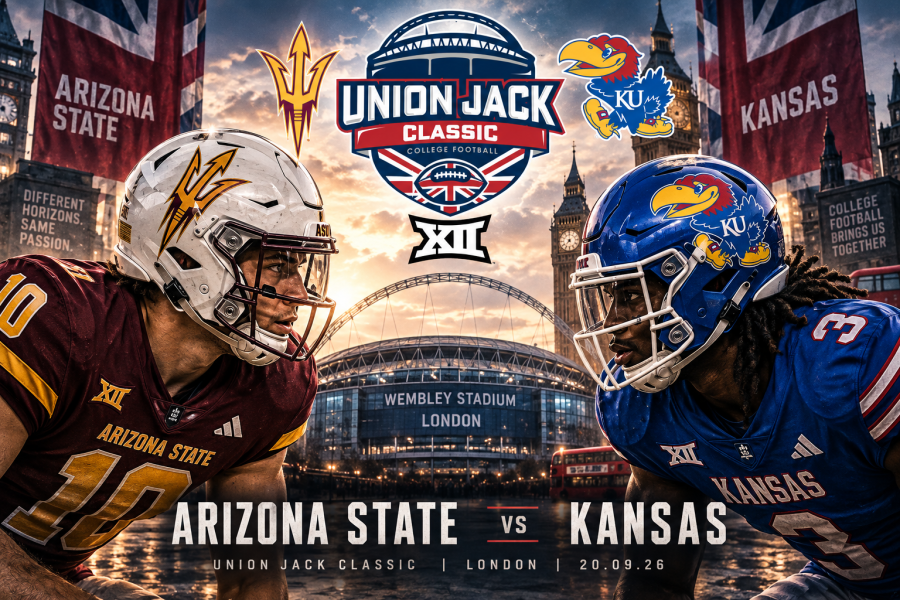
KEY BATTLE: CUTTER BOLEY VS THE KANSAS PASS RUSH
If Arizona State is to leave London with a win on Saturday, Kansas will surely have to find a way of disrupting quarterback Cutter Boley.
The Kentucky transfer has made an immediate impact since arriving in Tempe. Through his opening two games as a Sun Devil, Boley has completed 42 of 61 passes for 641 yards and eight touchdowns, averaging more than 320 passing yards per game.
Admittedly these numbers are inflated by an explosive opening performance against Morgan State, however it was quite an introduction which had Sun Devil fans pretty excited by what they saw. In his debut in maroon and gold Boley threw for 387 yards and six touchdowns as Arizona State rolled to a 70-7 victory.
The more interesting evidence perhaps came a week later against Texas A&M.
Facing a significant step up in quality of opposition, Boley still passed for 254 yards and two touchdowns. In doing so he showed that he can move the football against a much stronger defense.
However, the Aggies also provided Kansas with a blueprint for slowing him down.
As the Aggies dialled up the heat late in the game the signs emerged that Boley is less than comfortable under pressure. Boley threw two fourth-quarter interceptions, including one particularly costly play when Texas A&M edge rusher T.J. Searcy affected his throw and fellow defensive end Marco Jones intercepted for a touchdown.
The takeaway for Lance Leipold & Defensive Co-ordinator D.K. McDonald might just be that the Jayhawks focus less on stopping Boley altogether and more about putting the pressure on to make mistakes.
THE JAYHAWK WHO COULD DISRUPT HIM
That puts Kansas defensive end Leroy Harris III firmly in the spotlight.
Harris led the Jayhawks with 4.5 sacks and recorded 6.5 tackles for loss in 2025. He has carried forward that form into the new season showing his ability to disrupt even when he doesn’t get all the way to the quarterback.
Against LIU, Harris recorded four tackles for loss and a quarterback hurry. Against Missouri he added four tackles, forced a fumble and broke up two passes.
Kansas can also generate pressure from elsewhere. Linebacker Trey Lathan gives the Jayhawks another option as a blitzer, while David Santiago provides yet another threat off the edge.
But Harris looks like the player Arizona State — and Boley in particular — will need to account for.
Boley has already demonstrated during his first two games that, given time and rhythm, he can punish a defense.
However Texas A&M also demonstrated what can happen when that rhythm is disturbed.
For Kansas, the challenge on Saturday might not simply be stopping Cutter Boley.
It might be making sure he never gets comfortable.
KEY BATTLE: ASU RECEIVERS VS KANSAS SECONDARY

KEY BATTLE: ASU RECEIVERS VS KANSAS SECONDARY
Stopping Cutter Boley is one problem for Kansas. Containing the collection of weapons he has at his disposal presents another.
Arizona State entered the season with the headache of replacing star wideout Jordyn Tyson. Rather than looking towards one receiver to fill that void, the Sun Devils have assembled a deep and potentially dangerous group around their new quarterback.
Through two games, Reed Harris has emerged as perhaps the biggest individual threat from this group.
The 6-foot-5, 220-pound Boston College transfer has 15 receptions for 326 yards and four touchdowns already this season.
After opening with six catches for 137 yards against Morgan State, Harris demonstrated that his production wasn’t simply a product of the opposition. Against Texas A&M he caught nine passes for 189 yards and two touchdowns.
And Harris isn’t Boley’s only option.
Colorado transfer Omarion Miller leads ASU with 17 receptions through two games. Miller was held to only 29 yards on nine catches by Texas A&M, but arrived in Tempe after recording 808 receiving yards and eight touchdowns for Colorado last season.
Then there is Grayson Rigdon, who had 110 receiving yards and two touchdowns in the opener. ASU remarkably had three different 100-yard receivers in that game — Harris, Rigdon and Miller.
Collectively, the numbers demonstrate the problem Kansas faces.
Arizona State has accumulated 503 yards after the catch through its opening two games, third-most nationally, while averaging 10.7 yards after the catch per reception.
CAN THE KANSAS SECONDARY RESPOND?
This matchup becomes particularly interesting following what happened to Kansas against Missouri.
After allowing 292 passing yards against Missouri, there may be few tougher assignments for the Kansas secondary than facing one of the country’s most productive early-season quarterback-receiver combinations at Wembley.
Missouri quarterback Austin Simmons completed 19 of 29 passes for 292 yards and three touchdowns against the Jayhawks, repeatedly finding opportunities to get the ball out quickly.
It is an issue Kansas has acknowledged ahead of Saturday’s game.
Safety Corey Gordon admitted that the Jayhawks’ defensive backs “kind of play off a lot” and suggested that has to change against Arizona State.
“As defensive backs, we need to go get in people’s faces, be aggressive and compete and then make those guys throw shots over our head,” Gordon said.
Defensive coordinator D.K. McDonald echoed that assessment, saying Kansas had done “a poor job of locking on guys” against Missouri and allowing Simmons to move too easily through the passing game.
That could be particularly dangerous against an Arizona State receiving corps which has already demonstrated an ability to turn short completions into significant gains.
KEY BATTLE: ASU RUN GAME VS KANSAS FRONT SEVEN
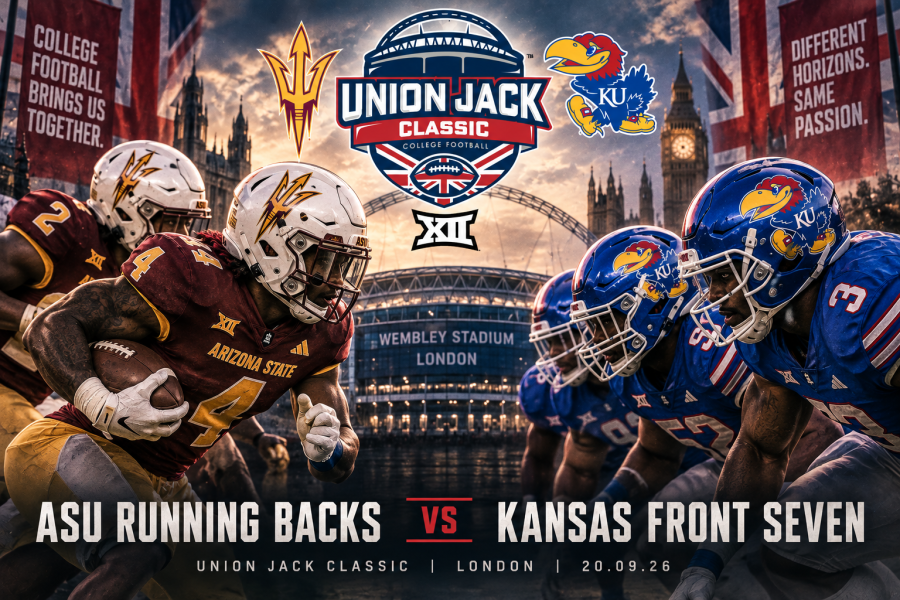
KEY BATTLE: ASU RUN GAME VS KANSAS FRONT SEVEN
The Arizona State backfield looks considerably different from the one which powered the Sun Devils to the College Football Playoff two seasons ago.
In 2024, the identity of the running game was unmistakable. Cam Skattebo carried the ball 293 times for a school-record 1,711 yards and 21 touchdowns, adding another 605 yards through the air. When Arizona State needed yards, everyone knew where the football was likely to go.
There isn’t another Skattebo in Tempe but perhaps there doesn’t need to be.
The 2026 approach is deliberately different. Kenny Dillingham and RB coach Shaun Aguano entered the season talking about a genuine committee, potentially using more two-back personnel. Aguano described having “seven great guys in that room”, while ASU itself called the group perhaps its most talented position group from top to bottom.
Kenny Dillingham has assembled a deeper and more varied running-back room, with Kyson Brown currently leading the way. Brown has rushed for 146 yards on just 19 carries through two games, but ASU has options behind him including Jason Brown Jr., Demarius Robinson and the more physical Marquis Gillis and David Avit.
Where Skattebo provided Arizona State with a bell-cow back capable of carrying an offense, the 2026 Sun Devils can attack a defense with different styles and personnel.
For Kansas, that means the challenge isn’t identifying where the running game is coming from. It’s dealing with whichever version of it Arizona State puts on the field.
With Cutter Boley and Arizona State’s passing attack demanding so much attention, Kansas cannot afford to overlook a Sun Devil running game which has shown plenty of early-season promise.
Kyson Brown has established himself as ASU’s leading back through the opening two games, carrying 19 times for 146 yards and a touchdown — an average of 7.7 yards per carry.
Brown needed only six carries to produce 80 yards against Morgan State, including a 46-yard run, but perhaps more significant was what he managed against Texas A&M.
Facing a much stronger defensive front, Brown carried 13 times for 66 yards, averaging just over five yards per attempt. Arizona State as a team rushed for 115 yards against the Aggies, although it was unable to find the end zone on the ground.
That makes establishing Brown — and keeping some balance alongside Boley — another important part of the equation for ASU at Wembley.
CAN KANSAS WIN in the trenches
There were actually encouraging signs for the Kansas run defense despite the 38-21 defeat to Missouri.
The Jayhawks did a good job containing Missouri’s stretch and outside-zone running game for much of the contest, with the defensive ends setting the edge and Kansas getting support from its linebackers and safeties.
But there was one glaring exception.
Missouri running back Jamal Roberts broke through the middle for a 64-yard touchdown after Kansas over-pursued a delayed handoff.
Linebacker Trey Lathan subsequently described the breakdown simply as “bad eyes.”
That could be an important detail against Arizona State.
Kansas has already demonstrated that it can defend the edge and make life difficult for a conventional running attack. The challenge will be maintaining that discipline while simultaneously accounting for Boley and ASU’s passing game.
Lathan should be central to that battle.
The veteran linebacker led Kansas with nine tackles against Missouri after recording 86 tackles in 2025, while defensive end Leroy Harris III continues to make plays around the line of scrimmage.
Harris forced a fumble against Missouri and has already demonstrated his ability to set the edge and pursue ball carriers from the backside.
For Arizona State, the run game doesn’t necessarily have to dominate.
If Brown can consistently produce four or five yards and keep Kansas honest, it prevents the Jayhawks from simply turning their attention towards Boley and the passing game.
For Kansas, meanwhile, the challenge is discipline.
The Jayhawks showed against Missouri that they can contain a talented running back.
They also showed how one mistake with their eyes can turn a well-defended running game into six points.
Tickets to watch the Sun Devils against the Jayhawks in the inaugural Union Jack Classic on Saturday September 19 can be purchased now via the Union Jack Classic website

George Somerville
College Football Writer
GEORGE IS A LONG STANDING FANATIC OF LIFE AND FOOTBALL IN THE DEEP SOUTH AND WRITES HIS WEEKLY COLUMN “IT’S ONLY SEC” FOR THE TOUCHDOWN.
GEORGE HAS REPORTED LIVE FROM GAMES ACROSS THE DEEP SOUTH INCLUDING THE SEC CHAMPIONSHIP AND NATIONAL CHAMPIONSHIP GAMES.
HE IS ALSO CO-HOST OF THE COLLEGE CHAPS PODCAST, THE UK’S FIRST AND ORIGINAL PODCAST DEDICATED SOLELY TO THE COLLEGE GAME.