
Bearcats and RedHawks: A Rivalry for the Ages as the Victory Bell Rings in Cincinnati
By Peter Mann
As eyes on British soil this coming weekend gaze upon the transatlantic showdown that is the Union Jack Classic at Wembley Stadium, between Kansas Jayhawks and Arizona State Sun Devils, there’ll also be plenty of focus stateside on another rivalry the same day, the one concerning bragging rights in Ohio.
This week our resident history buff plunges into some of the archives of one of the Victory Bell games, which are contested throughout the college football season, this being the Cincinnati Bearcats and the Miami RedHawks, which dates back to 1888.
The oldest of the non-conference rivalries stateside, the Bearcats and the Jayhawks first met in early December, as the RedHawks registered five victories in the first seven meetings, it finishing in a scoreless tie – surprising, perhaps, but when you delve deeper into the history of this rivalry, it wasn’t to be the last time.
With their respective colleges being founded some seven to eight decades prior to their football programs, the rivalry put on since is said to be the longest, continuous rivalry west of the Allegheny Mountains.
Scoreless games and shutout victories; zero has been a magic number for this rivalry down the years
Since that very first meeting, nearly 140 years gone now, the Bearcats and the RedHawks have often had the number ZERO in their respective meetings; four times have these two shared a scoreless game, in 1888, 1906, 1918, and 1936.
Add on to that, there have also been an impressive thirty-five shutout victories shared – that’s thirty-nine games overall a program has failed to register a point in; fourteen of those occasions landed in the first eighteen meetings, the Bearcats with eight to the RedHawks’ four.
It was also during this period that the Bearcats registered their biggest victory in the Victory Bell rivalry, putting up forty-six unanswered points, at their Nippert Stadium home, on 15 October 1904.
There have also been two occasions, one apiece, that a program has shut out their opponent over four consecutive meetings, the Bearcats doing so first, with four straight victories between 1897-99, then the RedHawks followed up with three victories and a tied game two decades later, between 1916-19.
It would be until the late 1990s that the RedHawks, when putting on their biggest victory, came close to matching that of their rivals, winning 41-0 in Cincinnati on 24 October 1998; there’s only been three shut-out successes since then.
The last of those shutout victories came at Paul Brown Stadium, Cincinnati, on 8 September 2018, with the Bearcats in the midst of what became a sixteen-game winning streak, putting up twenty-one unanswered in this one.
The RedHawks have tasted victory just twice over the past two decades, a far cry from their early dominance in this fixture, and that in which they put on throughout the sixties and seventies.
The power of four; coaches to have led both Bearcats and RedHawks
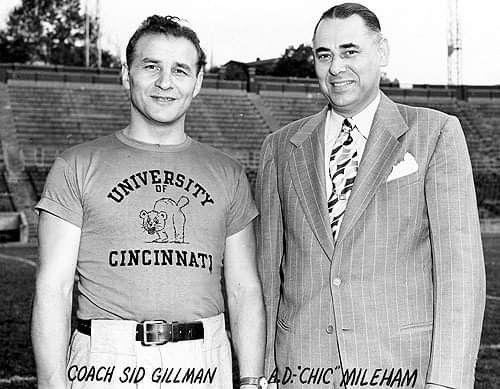
Throughout the long history of this fixture, four gentlemen have coached at both Cincinnati Bearcats and Miami RedHawks, they being Amos Foster, George Little, Sid Gillman, and George Blackburn.
Miami is also known for its famed ‘Cradle of Coaches,’ a phrase dating back to the late 1950s and which sees the area having produced a vast number of successful, sporting coaches over the decades since.
Among those sports produced here, a large cohort are football-oriented, and this includes NFL alumni, Paul Brown (Cleveland Browns), Weeb Ewbank (New York Jets), John Harbaugh (New York Giants), and Sean McVay (Los Angeles Rams), along with two of the aforementioned quartet, Little and Gillman.
Amos Foster (1880-1952) was the first to represent both programs in a coaching capacity; born in New Hampshire, Foster played both football and basketball for the Dartmouth Big Green in the early 1900s, before doing similar at Cincinnati.
Whilst with the Bearcats, Foster coached their basketball team between 1904-09, leading them to an undefeated Ohio Collegiate Championship in 1908; he also held the reins for their football program for two seasons, winning eleven of their fifteen games over 1904 and 1905.
Foster spent a year leading the Nebraska Cornhuskers (1906), before taking over at the RedHawks, again for two seasons, winning thirteen of fourteen outings, which included an undefeated second season (1907) when they went 7-0 – back then the RedHawks were known as the Redskins, and put up six shutout victories, outscoring opponents by 113-10.
George Little (1889-1957) was born shy of a decade after Foster, in Washington DC, going on to play guard for Ohio Wesleyan Battling Bishops between 1909-11; like Foster before him, Little also coached football and basketball, doing so in both Cincinnati and Miami.
He would take on those roles with the Bearcats between 1914-16, then with the RedHawks between 1916-22, his tenure there interrupted by World War One, where he would serve as a captain in the Infantry.
It was whilst with the RedHawks that Little led them to a pair of Ohio Athletic Conference titles, doing so in both 1916 and 1921, following undefeated seasons, posting an eventual winning record there of 37-3-2 – those three losses, shutout defeats to Oberlin, Wittenberg, and perhaps poetically, Cincinnati, on 25 November 1920.
After leaving Mimi, Little would be seen to coach football at Michigan Wolverines and Wisconsin Badgers, between 1922-26, whilst he also had a brief spell coaching baseball in Miami. He’d then hold administrative positions in Miami, Michigan, Wisconsin, and at Rutgers, over the next two decades, being inducted into the College Football Hall of Fame in 1955.
A long and varied career before Minnesota’s Sid Gillman (1911-2003), and played college football for the Ohio State Buckeyes on offense, in the early 1930s, becoming co-captain and being named to the All-American and All-Big Ten Conference teams.
In 1936, Gillman would play a season for the Cleveland Rams in the American Football League as a receiver, before returning to coaching permanently; Gillman, at the time of his playing for the Rams, had been an assistant coach at both Michigan State and Denison during the mid-thirties, a career path that would encompass some five decades of his life.
Between 1942 and ’47, Gillman would be assistant coach, then head coach, for the RedHawks, posting a winning record of 31-6-1 whilst at the helm; then, after a brief spell with the Army, took on the Bearcats position, enjoying a successful, six-year spell at the helm.
In three of his first four seasons in Cincinnati, Gillman led the Bearcats to the Mid-American Conference title, claiming the Glass Bowl at the end of his first season there, before enjoying successful tenures across the AFL/NFL, holding coaching positions with Los Angeles Rams, Los Angeles/San Diego Chargers, Dallas Cowboys, Houston Oilers, Chicago Bears, and Philadelphia Eagles, claiming six divisional titles overall and, in 1963, the AFL Championship itself, against Boston (New England) Patriots.
Gillman has had several Hall of Fame inductions, including the Pro Football (1983) and College Football (1989); he died in his sleep, at the grand age of 91-years, in 2003, following a long, and oft-illustrious career.
And finally, the most recent to coach either side of the Ohio divide, George Blackburn (1913-2006); born in Columbus, Ohio, Blackburn played both football and baseball for Findlay Oilers in the mid-thirties.
His coaching career began with RedHawks, where he led them to the Mid-American Conference title in his first, and only, season (1948) at the helm; assistant roles then followed with the Bearcats and the Army, before he returned to lead the former of the two in the mid-fifties, leading them for six seasons before moving on again, this time to the Virginia Cavaliers, in the Atlantic Coast Conference.
In 1947, Blackburn was an assistant at the RedHawks (Redskins) to Sid Gillman as the two led the program to an undefeated, 9-0-1 season and the Sun Bowl, where they narrowly edged Texas Tech Red Raiders in El Paso, Texas.
That quartet of Foster, Little, Gillman, and Blackburn, combined with those in the aforementioned ‘Cradle of Coaches,’ goes to show just how strong a calibre of coaching comes from this small area of American soil.
Deaths, championships, comebacks and streaks; the Bearcats-RedHawks rivalry sure stands out from the crowd
There have been some interesting moments in this Victory Bell rivalry over the decades, from the death of James ‘Jimmy’ Nippert back in 1923 from blood poisoning to the Mid-American Conference Championship clash the Bearcats and RedHawks played out in 1950.
Over five decades later, future NFLer Ben Roethlisberger and the RedHawks were nearly stunned in a Bearcats comeback for the ages, and, just three years ago, there was the game which would see the RedHawks bring to a halt the aforementioned sixteen-game winning streak of the Bearcats which dated back to 2005 – there’s almost certainly been some interesting times.
A DEATH So, let’s begin by going back to the 1920s, and he with whom Cincinnati’s Nippert Stadium is named, James ‘Jimmy’ Nippert, and the aftermath of the Bearcats’ 23-0 victory over the rivals in November 1923, on Thanksgiving.
At some point during the Bearcats – RedHawks game, Nippert would receive a deep cut on what was described as being a ‘sea of mud’ due to the rainy deluge that the area had succumbed.
The last game of the 1923 season, Nippert received a gash on his leg, which, due to the conditions in which they were playing, was quickly covered in thick, wet mud, likely congealing together with blood and sinew from within.
Seeing out the game, Nippert soon took ill with infection at home, convalescing afterwards, and, despite being admitted to hospital and teammates being checked for possible transfusions, he sadly passed away on Christmas Day.
Nippert’s death certificate would state that his cause of death was due to “septicaemia following injured left leg. Football Accident,” with the Bearcats’ stadium being completed in his memory, and thanks to a sizeable donation from Nippert’s grandfather, James Gamble (co-founder of the Procter & Gamble Company).
A CHAMPIONSHIP Fast-forward a quarter century, and another weather-affected encounter took place between the two programs; November 1950 would see the two collide for the MAC championship, in the midst of a snowstorm.
It would be a game which the Redhawks went on to win 28-0, inflicting the Bearcats’ third regular season defeat (finished 8-3), a shock loss at that; still known as the Miami Redskins at the time, Woody Hayes claimed the title when inflicting a first shutout loss on Gillman’s program.
At the time, the Cincinnati Enquirer reporter, Dick Forbes, opened his newspaper report the following day with: “Miami’s Redskins, striking with all the raging power of the snowblizzard in which they played, yesterday handed University of Cincinnati one of its most startling football defeats of all time.”
Forbes added later in his report, about the magnitude of the result, that: “It was a surprising spectacle for a number of reasons, the weather the least of them, but Miami came through to lick its long-time rival simply because Redskins could do no wrong while the Bearcats could do nothing right.
“As a result, Miami was able to keep a Gillman-coached team from scoring for the first time and captured the Mid-American Conference championship from a club which trounced them 27-6 last year, and achieved victory over a team already headed for the Sun Bowl…”
Cincinnati went on to lose the Sun Bowl as well, edged 13-14 against West Texas State Buffaloes on New Year’s Day; Miami meanwhile, having completed an 8-1 regular season, went on to lift the Salad Bowl following a 34-21 success over Arizona State Sun Devils, in Arizona, the same day as their rivals lost.
THE COMEBACK Other than a last-second hail mary, or a successful field goal at the death, the most exciting part of any sporting game is that of the comeback; this rivalry had one such event take place over a half century on from MAC championship decider, and the near-comeback that took place in late September 2003.
Ben Roethlisberger, a future two-time Super Bowl winner and Pittsburgh Steelers legend (2004-21), spent his college years in the early 200s, donning the jersey of the Miami RedHawks, posting 377 yards, 2TDs (pass) – at the time he was the first quarterback in Miami school history to surpass 300yds in three straight games.
Miami led 28-0 early in the second quarter before Cincinnati bagged seventeen unanswered points to move within nine as the half came to a close; Miami then moved into a 42-17 lead, before Cincinnati added three more scores in the final eight minutes of the contest as Miami clung on for a 42-37 victory.
BREAKING THE STREAK Two decades later, Miami had been in something of a lull where the Victory Bell was concerned; Cincinnati had racked up sixteen straight victories, from 2006 onwards, ten of which had the Bearcats putting on a 30+ score.
At Nippert in 2012, the Bearcats won 52-14, alongside three shutout successes in 2011 (27-0), 2013 (14-0), and 2018 (21-0); The RedHawks’ last success before 2023 was a 44-16 win at Yager Stadium, Miami, in September 2005.
The 2023 contest between the two rivals, which of course went to overtime, saw Miami come out on top with a 31-24 win, scoring a touchdown in overtime after they had tied the contest with a field goal attempt in the closing stages of regulation time.
It was the third game of the season, and Miami quarterback Brett Gabbert registered 237 yards, 2TDs (pass). Graham Nicholson kicked through the 20-yard field goal to tie the game up and send it to overtime, before Gabbert hit Joe Wilkins from close range for the game-winning score – Carter Brown’s boot kept Cincinnati in the running, he kicking through three field goals of his own.
The victory ended the sixteen-game winning streak from the Bearcats, and, at the time, tied the series up at 60-60-7; the Bearcats, though, returned to winning ways twelve months later, winning 27-16 in September 2024, at Yager.
Now it’s on to a new stadium, the TQL Stadium, for the next instalment, but first, and finally with this instalment, let’s take a quick look at meetings between the two Ohio programs since the turn of the Millennium, and that impressive streak; well, impressive if you’re a Bearcats fan at least.
There’s even been a case of a mysterious, disappearing trophy in the 1930s, it reappearing in the mid-forties, whilst the current trophy hoisted by the victors is a replica of the original.
High-scoring meetings and recent clashes aplenty in the oldest of rivalries
Just a couple of years removed from the biggest win in the historical series by Miami RedHawks (41-0; 24 October 1988), did the ‘Battle for the Victory Bell’ become turned up a notch or five.
The highest scoring game occurred twelve months on from Miami’s biggest, with some 94 points being plundered in the 1999 collision at Yager Stadium as the Bearcats claimed a 10pt, 52-42 success.
For the Bearcats, it was the highlight of a low season; for the casual observer, a footnote, with Rick Minter’s program flailing to a 3-8 season, with the Bearcats head coach saying of the victory: “I know it sounds crazy when we gave up 42 points and however many yards they got (408).
“But I thought the key was the way our defense kept us in the game early when our offense was fiddling around and putting the ball on the ground.”
Whilst Minter’s counterpart in the RedHawks dugout, Terry Hoeppner, added, “I’m really in shock.
“I never expected them to be able to move the ball on us like they did.
“I never expected for us to move the ball that well on them, for that matter, but that’s pretty hollow when you lose and give up 52 points.”
Both Minter and Hoeppner were one of but a handful of longer-serving coaches at their respective programs, the former registering ten seasons (1994-2003, Humanitarian Bowl, and Conference USA championship) with the Bearcats and the latter six seasons (1999-2004, GMAC Bowl, and Mid-American Conference championship) with the RedHawks.
The pair have proved to be highlights of the last quarter century in Ohio, with more recent seat-holders, Luke Fickell (2017-22, Bearcats) and Chuck Martin (RedHawks) stepping things up to another level.
Fickell’s Bearcats claimed a Military Bowl, a Birmingham Bowl, and back-to-back (2020 & 2021) American Athletic Conference titles, with former Atlanta Falcons quarterback Desmond Ridder stirring things up over a four-season marathon in Cincinnati (50 games, 10,239yds, 87TDs passing; 2,180yds, 28TDs rushing).
On the flip side, and still holding seat with the RedHawks, the erstwhile and experienced Martin, who, before Miami, earned his coaching spurs through lengthy spells with Grand Valley State Lakers (2000-09) and Notre Dame Fighting Irish (2010-13), boasting a 74-7, trophy-laden spell with the Lakers.
Although not quite hitting those heights in Miami, Martin’s charges have won the Frisco Football Classic, Arizona Bowl, three MAC East, and two MAC championships – last season’s quarterback, Dequan Finn, moving on to pastures new and the Paris Lights in the inaugural American Football League Europe (AFLE).
Finn replaced an experienced QB in Brett Grabbert in the slot at Miami, his predecessor having put in 52 games over six campaigns, registering 10,814yds, 80TDs (pass), 482yds, 8TDs (rush) between 2019-24.
Unaware of what was to come, results either side of the millennium went primarily in favour of the RedHawks, they winning six of the eleven meetings between 1995 and 2005, including that 41-0 highlight reel, and a trio of successes between 2001-03 (21-14, 31-26, 42-37).
Before ending the streak three years ago, the RedHawks’ last success in the Victory Bell arrived at Yager Stadium, late September 2005, where they won 44-16; it was all downhill from there as Bearcats head coaches Brian Kelly (2006-09), Butch Jones (2010-12), Tommy Tuberville (2013-16), and Luke Fickell (2017-21) also tasted success after success.
The last two meetings of the two Ohio programs saw, thirty-six months gone, a 31-24OT success for the RedHawks (216 September 2023), the result that ended the streak, and a back-and-forth encounter.
Gabbert enjoyed himself on the field with 237 yards, 3TDs (pass), opening the scoring with a 79-yard toss for wide receiver Gage Larvadian, as well as connecting with Javon Tracy (17yds), and in overtime, to Joe Wilkins from close range for the win.
Replying for the Bearcats, Corey Kiner had an early game rushing score, whilst the boot of Carter Brown kept them in the game with three from range (28yds, 23yds, 23yds), with quarterback Emory Jones grabbing a fourth-quarter rushing score, and a two-point conversion pass to tight end Chamon Metayer, making things interesting.
Meanwhile, last time around, twenty-four months ago (14 September 2024) and a 27-16 victory for the Bearcats; quarterback Brendan Sorsby registered with 186yds, 1TD (pass), and running back Corey Kiner 126yds, 1TD (rush), whilst the RedHawks replied through quarterback Gabbert’s 339yds, 2TDs (pass).
That contest was opened and closed by a pair of 50+ field goal attempts from Bearcats kicker Nathan Hawks, over 55yds (first quarter), and 50yds (fourth quarter).
Now, it’s on to Cincinnati’s TQL Stadium, the seventh venue in which the Ohio Victory Bell has been contested; Nippert Stadium has hosted the most games with 84, followed by Yager Stadium’s 19, other venues being that of Miami Field (11), Union Ball Park (7), Riverfront Stadium (4), and Paycor Stadium (3).
At present, due to cancellations of the 2027, 2028, and 2029 meetings, this will be the last officially scheduled meeting between Cincinnati Bearcats and Miami RedHawks for the Victory Bell.

Peter Mann
COLLEGE FOOTBALL ANALYST
PETER IS A LIFELONG SPORTS FAN, JOURNALIST AND AUTHOR BASED IN COUNTY DURHAM. HE HAS FOLLOWED THE NFL AND THE RAIDERS SINCE THE 1980s, AND LOVES BOTH SPORTS AND FAMILY HISTORY. PETER HAS A DEGREE IN SPORT & EXERCISE PSYCHOLOGY, AND CAN BE FOUND ON TWITTER @petermannwriter.