
Aer Lingus College Football Classic Preview: A History of North Carolina Football
By Simon Carroll
North Carolina is famous for basketball. VERY famous for basketball.
Mention Chapel Hill to a casual American sports fan and there is a good chance their first thought will be Michael Jordan, Dean Smith, March Madness and a particularly fierce rivalry with Duke.
But long before the Tar Heels became one of the biggest names in college basketball, North Carolina was playing football. In fact, the Tar Heels have been playing football since 1888, making the program one of the oldest in the United States. More than 130 years later, the sport remains a major part of the university’s identity — even if the football team has spent much of that time living in the shadow of its more successful basketball sibling.
That long history has produced legendary players, famous coaches, some genuinely strange moments and one particularly notorious academic scandal.
The Tar Heels are Really, Really Old
North Carolina’s first football game came in 1888 against Wake Forest.
The game looked almost nothing like modern football. The field was different, the scoring system was different and the rules were still evolving. A touchdown was worth four points, a conversion was worth two and a field goal was worth five.
Even stranger, North Carolina briefly decided that football was too dangerous. After a player suffered a broken collarbone in 1890, the university banned the sport. The ban lasted one season; the students wanted their football back, and football returned in 1891. Aside from interruptions during the First World War, North Carolina has been playing ever since.
So when the Tar Heels arrive in Dublin, they will be representing a football program that predates the invention of the forward pass.
Why are they Called the Tar Heels?
The nickname is one of the best in college sports, although its origins are considerably less glamorous than you might expect.
North Carolina was historically one of America’s biggest producers of tar, pitch and turpentine, thanks to its vast pine forests. Workers involved in the industry could end up with the sticky material covering their feet.
Hence: Tar Heels.
The term was not initially a compliment. Over time, however, North Carolinians embraced it, particularly during the Civil War, when soldiers from the state began using “Tar Heel” as a term of pride. The name eventually became attached to the university and its athletic teams.
The colour is equally distinctive.
Carolina Blue is one of the most recognisable shades in American sport, and its origins can be traced back to UNC’s two historic debating societies. The Dialectic Society adopted light blue while the Philanthropic Society chose white, and those colours eventually became the university’s athletic colours.
If you spend any time around Dublin on game weekend, you should have little trouble spotting the Carolina supporters.
Meet Rameses
Meet the newest member of Carolina royalty, Otis.
— The University of North Carolina at Chapel Hill (@UNC) November 19, 2020
After nearly a decade on the throne, Rameses XXI is retiring from public life. He's passing down his royal garb to his successor who has been hard at work preparing for his new role: https://t.co/Yr3qQd92Gt #UNC pic.twitter.com/1o13VVPHCd
Most college football mascots are either animals or humans dressed as animals.
North Carolina has a ram.
His name is Rameses, and he has been part of the Tar Heel story for more than a century. The idea for a ram mascot came from cheerleader Vic Huggins in 1924, inspired partly by Carolina football star Jack Merritt, who had been nicknamed the “Battering Ram.”
The first Rameses was brought in from Texas and introduced before a game against VMI. The Tar Heels were locked at 0-0 late in the game when kicker Bunn Hackney rubbed Rameses’ head for luck before attempting a 30-yard field goal. He made it, and North Carolina won 3-0.
And Rameses was apparently never going to be allowed to leave after that.
Charlie 'Choo Choo' Justice
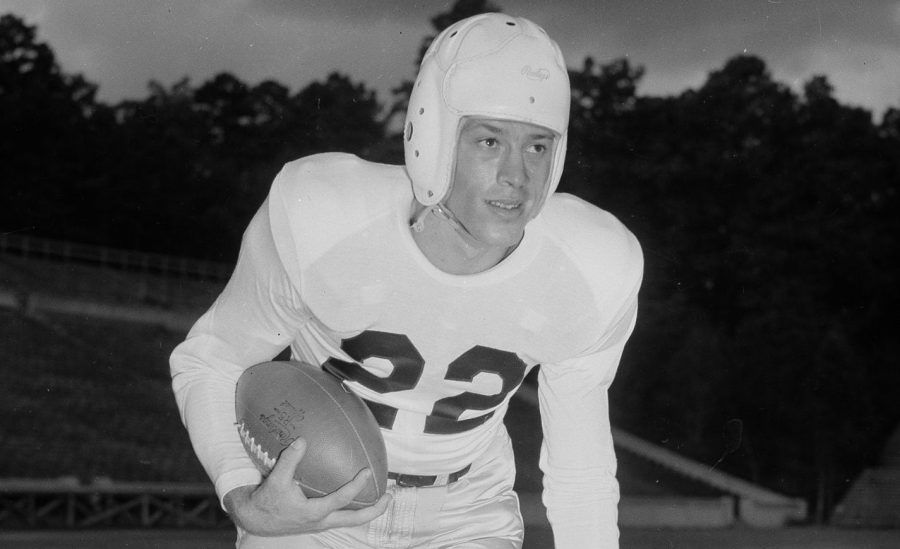
North Carolina’s first true football superstar was Charlie Justice. Justice played for the Tar Heels from 1946 to 1949 and became one of the biggest sporting personalities in the American South. He could run, pass and punt, and was so influential that he helped turn Carolina football into a major regional attraction. Justice finished second in the Heisman Trophy voting twice, and led North Carolina to three major bowl appearances during his time in Chapel Hill.
Justice also became the first Tar Heel football player to have his number retired – a sign of things to come for this football team. If the history of North Carolina football has one defining characteristic, it is that the school has regularly produced players who became bigger than the program itself.
The next one would be considerably more intimidating.
Lawrence Taylor Arrives
One of the Top Two Players to EVER Play at North Carolina, Tar Heel Legend Lawrence Taylor. #UNCommon #unc #tarheels #GoHeels #ACC #CarolinaFamily #CarolinaFootball #GDTBATH #UNCfootball pic.twitter.com/FHxeCSG2oo
— Blue Heaven (@uncsportsphotos) February 1, 2023
Lawrence Taylor is arguably the greatest football player North Carolina has ever produced.
Before he became an NFL icon with the New York Giants, Taylor spent his college career in Chapel Hill from 1977 to 1980. He eventually became a devastating pass rusher, recording 16 sacks during his senior season and helping North Carolina to an 11-1 record and an ACC championship.
Taylor was a unanimous All-American and left Chapel Hill as one of the most feared defenders in college football. As many will be aware, The New York Giants would select him second overall in the 1981 NFL Draft.
The rest is history.
Taylor became one of the greatest defensive players in NFL history, revolutionised the way teams thought about rushing the passer and helped establish the modern superstar linebacker.
But he was not the only NFL-calibre talent to come through Chapel Hill. Julius Peppers, Dre Bly and more recently Sam Howell and Drake Maye have all gone on to prominent professional careers.
North Carolina has often been better at producing NFL players than its win-loss record would suggest.
Mack Brown and the Rise of the Tar Heels
Is there a coach, in college football, that's having more fun after wins than Mack Brown with North Carolina this season? 😂🕺 pic.twitter.com/EIeAlr9FAe
— Taylor Vippolis (@tvippolis) December 17, 2019
Mack Brown became North Carolina’s head coach in 1988 and eventually turned the program into a consistent national presence, something the resources at the school’s disposal had been demanding for some time.
Brown’s first stint in Chapel Hill ended in 1997, when he left for Texas, where he would eventually win the national championship in 2005. He subsequently returned to North Carolina in 2019 and quickly restored some of the excitement around the program.
Under Brown’s second stewardship, the 2020 Tar Heels reached the Orange Bowl, while the 2022 team won the ACC Coastal Division. And Chapel Hill became synonymous with elite quarterback talent throughout this period.
Sam Howell became a star before entering the NFL, while Drake Maye emerged as one of the country’s best quarterbacks and was selected third overall by the New England Patriots in the 2024 NFL Draft.
The Tar Heels had become a genuinely exciting offensive team.
Brown and UNC parted ways for good after the 2024 season, bringing the curtain down on the career of one of the most successful head coaches in College Football history.
The Scandal that Rocked Chapel Hill
3,100 students, half of them athletes, involved in massive academic fraud at UNC http://t.co/Hmb4F8dOQo pic.twitter.com/tQXO5EeynU
— New York Post Sports (@nypostsports) October 22, 2014
Mack Brown’s 14-year career break from Chapel Hill coincided with one of the darker chapters in the history of UNC collegiate sports. The academic scandal that engulfed North Carolina is complicated, controversial and important to the school’s modern history.
The initial football investigation began in 2010 after concerns surrounding agents, improper benefits, academic misconduct and the conduct of members of the football program. The NCAA eventually found violations involving the football program, including academic fraud and improper benefits. North Carolina received probation, lost scholarships and was given a postseason ban for the 2012 season. Wins from the 2008 and 2009 seasons were also vacated.
That was only part of the story.
A much broader controversy then emerged around the university’s Department of African, African American and Diaspora Studies, formerly known as African and Afro-American Studies.
Investigations found that the department had offered large numbers of so-called “paper classes” — courses in which students could receive grades without the normal academic requirements. A later Wainstein investigation found roughly 3,100 enrolments in the courses between 1993 and 2011, with student-athletes accounting for 47.6 percent of those enrolments.
That distinction is important because the scandal was not simply a football scandal. The paper-class system involved the wider student body, although athletes were disproportionately represented among those enrolled.
The NCAA’s eventual 2017 ruling also became one of the strangest elements of the saga. The infractions panel said it could not conclude that UNC had violated NCAA academic rules through the paper courses because the NCAA generally defers to universities on academic fraud matters. It did, however, punish former department chair Julius Nyang’oro and found a failure to cooperate with the investigation.
For North Carolina football, however, the damage to the program’s reputation had already been done.
It remains one of the most infamous academic scandals in modern college athletics.
Bill Belichick - the Latest Bizarre Twist in UNC Football History
BREAKING NEWS: The University of North Carolina is hiring Bill Belichick as their next head coach, per @AdamSchefter. This is happening. pic.twitter.com/7bmlXDqSkd
— Ari Meirov (@MySportsUpdate) December 11, 2024
Just when North Carolina football appeared to have exhausted its supply of bizarre storylines, the university hired one of the most successful coaches in NFL history.
Bill Belichick, the author of Six Super Bowl victories and two decades of dominance with the New England Patriots, decided he wanted in on college football.
That’s right, the man with a reputation for defensive football, meticulous preparation and answering media questions with approximately as much enthusiasm as somebody being asked to clean the Aviva Stadium after a particularly enthusiastic Irish stag party.
And suddenly, he was the head coach of the North Carolina Tar Heels.
The hire instantly transformed the national perception of the program, similar to that in Colorado when Deion Sanders took charge. But Belichick’s first season did not go according to the Hollywood script.
His first game, ironically, was against TCU. Despite the Tar Heels scoring first, the Horned Frogs took over, scoring 41 unanswered points and eventually winning 48-14.
The capitulation proved to be a running theme throughout the year as North Carolina finished the 2025 season 4-8. With rumors that Belichick may already be on the hotseat, the rematch with the Horned Frogs in Dublin becomes particularly intriguing.
The Road to Dublin
1 WEEK TO GO 🙌
— Aer Lingus College Football Classic (@cfbireland) August 22, 2026
The time has nearly come, College Football returns to Dublin this time next week when @tcufootball & @uncfootball face off in the Aer Lingus College Football Classic🏆
Cheerleaders, Pep Rallies, Marching Bands and an atmosphere unlike anything else all in one… pic.twitter.com/5IINDhYggB
The Tar Heels have played TCU four times in their history. Before last year’s meeting, North Carolina had won every encounter: 1940, 1994 and 1997.
Now the series moves from Chapel Hill to Dublin.
For North Carolina, the game is an opportunity to begin writing a very different chapter under Belichick. The Tar Heels have an extraordinary history, but they have never quite managed to turn their football tradition into sustained national dominance.
They have the ancient origins, the famous nickname, Carolina Blue, Rameses and a long list of legendary players. They have Charlie Justice and Lawrence Taylor. They have Mack Brown, Drake Maye and now one of the most famous coaches in the history of the NFL.
They also have a few chapters they would probably rather forget. But that is what makes the Tar Heels such an interesting team to get to know.
UNC are not simply the basketball school. They are one of the oldest football programs in America, with more than a century of stories behind them.
And after last year’s shellacking by the very same opponents they face in Week 0 this year, they arrive in Dublin with a particularly good reason to add another one.

SIMON CARROLL
HEAD OF CFB/NFL DRAFT CONTENT
PREVIOUSLY THE FOUNDER OF NFL DRAFT UK, SIMON HAS BEEN COVERING COLLEGE FOOTBALL AND THE NFL DRAFT SINCE 2009. BASED IN MANCHESTER, SIMON IS ALSO CO-CREATOR & WEEKLY GUEST OF THE COLLAPSING POCKET PODCAST, IS A COLLEGE FOOTBALL WRITER FOR DAZN AND COVERS THE JACKSONVILLE JAGUARS FOR SB NATION.
A huge thank you to Shomari for taking the time to talk to us. Everyone at The Touchdown wishes him well in his future career.