
Rock Chalk: The Complicated History of Kansas Football
By Simon Carroll
There are college football programs whose histories are defined by sustained dominance, by dynasties and national championships, by generations of supporters who have grown accustomed to expecting victory.
Kansas is not one of them.
The Jayhawks occupy a rather more unusual place in the sport. Their football history stretches back to 1890, almost as far as the game itself, and has produced some of the greatest players in college football history, conference championships, major bowl victories and teams that briefly reached the very top of the national rankings. It has also produced extraordinary inconsistency, coaching upheaval, scandals, long periods of irrelevance and some of the most difficult years imaginable for a major college football program.
That contradiction is what makes Kansas fascinating.
This is a program whose history contains Gale Sayers, John Riggins and John Hadl; whose greatest modern team finished 12–1 and won the Orange Bowl; whose most successful coach left with a winning record amid controversy; and which, less than a decade later, endured a 27-game conference losing streak and a winless season.
It is also a program inseparable from the history of its state, its university and its most enduring rival.
To understand Kansas football, you have to start long before the first kickoff.
Before the Jayhawk
The University of Kansas was founded in 1865, with its first classes beginning the following year. Football arrived in 1890, when the university’s Athletic Association organized its first team.
The early years were not exactly a model of modern athletic administration. Kansas won 14 of its first 16 games across the 1891 and 1892 seasons, creating expectations that the young program could become one of the great football powers of the West. Those expectations quickly encouraged some less admirable practices. Kansas recruited paid players and allowed men who were not properly enrolled, or who were not meeting academic requirements, to play.
By the end of the nineteenth century, critics were questioning whether football was worth the trouble. The game itself was brutally different from the modern sport, with limited protective equipment and rules that did little to prevent serious injury. In 1896, a Doane College player named Bert Serf died after being knocked unconscious while making a tackle against Kansas.
At Kansas, the question of whether football should even continue became serious enough that, in 1910, members of the Board of Regents proposed abolishing the sport until its corruption and safety problems could be addressed. The motion failed, but the debate revealed something that would recur throughout Kansas football history: the program has rarely been able to separate its ambitions from the complications that come with them.
Even the earliest Jayhawks were caught up in questions of eligibility, professionalism, player safety and institutional control.
Kansas football was complicated from the beginning.
Why a Jayhawk?
Our unique KANSAS story will be told throughout the new Booth.
— Travis Goff (@tgoff11) July 17, 2025
Including highlighting the multiple war memorials on campus, what it means to be a Jayhawker, the history of bleeding Kansas, and our great state’s fight for being on the right side of history as a Free State.
So… https://t.co/Enc9dqk2jL
The name is older than the football team and considerably older than the university’s sporting identity.
During the period known as Bleeding Kansas in the 1850s, “Jayhawker” was used for anti-slavery forces operating in the territory. The term became associated with the violent struggle between pro-slavery and anti-slavery factions before the Civil War and eventually evolved into Kansas’ defining nickname.
That history matters because the Jayhawk is not simply a colorful bird chosen by an athletics department. Its origins are tied to one of the most politically and violently contested periods in American history.
The university’s relationship with Missouri makes that history even more significant. The two schools first met in football on October 31, 1891, in Kansas City, Missouri. Kansas won 22–8. The game began what is now one of the oldest rivalries in major college football, a series that would eventually become known as the Border War.
There is an important historical qualification, however. The idea that every Kansas-Missouri sporting contest has always been called the “Border War” is not quite true. That terminology is relatively modern, becoming widely established in the late twentieth and early twenty-first centuries. The rivalry itself is ancient; the name came later.
The underlying history is nevertheless real. Kansas and Missouri had been on opposing sides of the violent struggle over slavery and the future of the Kansas Territory, and both universities eventually adopted athletic identities with connections to that conflict. Missouri’s Tigers trace their name to the Missouri militia that defended Columbia during the Civil War.
By the time Kansas and Missouri began playing football, the political conflict had become history. The sporting rivalry, however, was only beginning.
Crimson and Blue
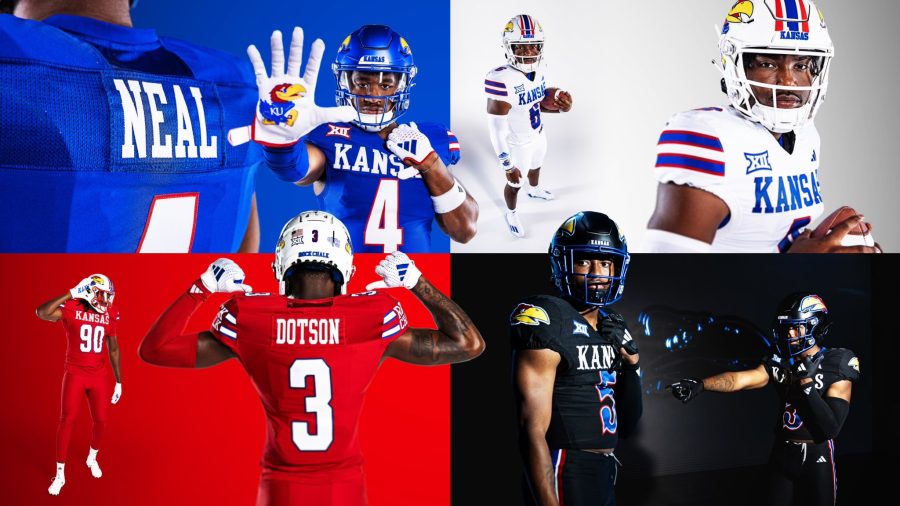
The colors now seem inseparable from Kansas: crimson, blue, the Jayhawk, and the famous “Rock Chalk” identity.
They were not always so. Kansas originally used sky blue and corn yellow. As intercollegiate athletics developed in the 1890s, those colors became less practical for football and baseball, where the uniforms had a habit of becoming dirty.
By 1891, the university was discussing alternatives. John J. McCook, a Harvard graduate and influential KU figure, advocated crimson and blue. Other suggestions were offered, including crimson and black and even brown and yellow.
By May 1896, crimson and blue had been settled upon as the university’s official combination.
The choice was not entirely free of outside influence. Harvard’s crimson had clearly entered the discussion, while the eventual combination also drew comparisons with other universities. But the colors stayed, and more than 125 years later they are among the most recognizable identities in college sports.
The Jayhawk, meanwhile, evolved into the distinctive cartoonish bird that Kansas fans know today. Its appearance changed repeatedly during the early twentieth century, but the character endured.
It became more than a mascot. It became Kansas.
The First Great Jayhawk
Long before Kansas became known primarily as a basketball school, the football program had already produced a sporting legend.
Tommy Johnson was one of the university’s earliest great athletes. As a quarterback, he led Kansas to a 23–2–1 record across three seasons and became a central figure in the school’s sporting culture.
His story also illustrates the danger of early football.
In 1909, Johnson scored a spectacular 70-yard touchdown against Nebraska and was carried from the field by jubilant Kansas supporters. Later that season, against Missouri, he suffered a concussion but remained in the game. A year later, another injury aggravated a kidney condition. Johnson’s health deteriorated and he died in 1911, aged only 24.
He was remembered for decades as one of the finest athletes Kansas had produced.
The university would eventually produce players whose fame extended far beyond Lawrence, but Johnson established a tradition that would become characteristic of Kansas football: extraordinary individual talent appearing even when the larger program struggled to maintain the same level of excellence.
Gale Sayers, John Hadl and John Riggins
The names associated with Kansas football’s greatest period of individual talent are familiar even to those who know little about the Jayhawks.
Gale Sayers arrived from Omaha and became the “Kansas Comet,” producing one of the most spectacular careers in school history between 1962 and 1964. He was a two-time All-American and finished his Kansas career averaging 6.5 yards per carry with 3,917 all-purpose yards. His 283-yard rushing performance against Oklahoma State in 1963 established both Kansas and Big Eight single-game records at the time.
His college career was remarkable enough. His professional career with the Chicago Bears made him immortal.
John Hadl, meanwhile, gave Kansas one of the great quarterbacks of its era. He became a star at Kansas between 1959 and 1961 before enjoying a lengthy professional career. John Riggins arrived soon afterward and developed into one of the most powerful running backs in the history of the NFL.
For Kansas, however, the presence of these players was about more than producing future NFL stars. It demonstrated that Lawrence could attract and develop elite football talent even when Kansas was not consistently competing with the nation’s best programs.
The problem was never quite finding great players. It was keeping everything around them at the same level.
1968: The Season Kansas Almost Became Something Else
Kansas’ most important football season before the modern era came in 1968.
The previous season had already provided an indication of what was possible. Pepper Rodgers inherited a team that had gone winless in conference play in 1966 and led it to a 5–2 Big Eight record in his first season, including a 10–0 upset of No. 8 Nebraska.
Then came 1968. Kansas opened with a 46–7 victory over Illinois, defeated nationally ranked Indiana 38–20 and destroyed New Mexico 68–7. The Jayhawks climbed to No. 6 in the national rankings before heading to Nebraska. They won there, too, 23–13.
Kansas finished the regular season 9–1, shared the Big Eight championship with Oklahoma and reached the Orange Bowl in Miami. The team featured quarterback Bobby Douglass and defensive end John Zook, both All-Americans, as well as a sophomore running back named John Riggins.
Kansas ultimately lost the Orange Bowl 15–14 to Penn State, but the significance of the season was much greater than the result. The Jayhawks finished No. 7 in the final Associated Press poll, at that point the highest finish in program history.
It remains the last time Kansas won a conference championship outright or shared one at the top of the standings.
And then came the part that perhaps best captures Kansas football; a year after reaching the Orange Bowl and finishing seventh in the country, Rodgers’ team went 1–9.
The rise had been extraordinary, the reversal almost as remarkable.
2007: The Impossible Season
If 1968 was the great historical Kansas team, 2007 was the season that turned the program into a national story.
Mark Mangino had been hired in 2002. His first Kansas team went 2–10. By 2005, the Jayhawks were 7–5. In 2006, they reached 6–6.
Then everything clicked.
Kansas opened the 2007 season with a series of convincing victories and eventually reached 11–0. The Jayhawks climbed as high as No. 2 in the national polls, the highest ranking in school history. They finished the regular season 11–1, with their only defeat ironically coming against Missouri. KU defeated Virginia Tech 24–21 in the Orange Bowl on January 3, 2008, completing a 12–1 season and giving the university its first BCS bowl victory. The team finished No. 7 in the final AP poll, matching the program’s 1968 high.
It was the greatest season Kansas football had ever produced. Mangino collected virtually every major national Coach of the Year award. Aqib Talib became one of the stars of the defense and later a first-round NFL draft pick. Todd Reesing became one of the most celebrated quarterbacks in school history.
For a program that had spent decades searching for a way to make success sustainable, it looked like the beginning of something. Instead, it became the high point before another collapse.
The Mangino Controversy
The story of Mark Mangino sadly cannot simply be reduced to the man who coached the greatest team in Kansas history. During the 2009 season, former and current Kansas players made allegations about Mangino’s treatment of players, including claims of verbal and emotional abuse. The university investigated the allegations. Kansas began that season 5–0 before losing seven consecutive games and finishing 5–7.
Mangino eventually resigned in December 2009. His final record at Kansas was 50–48, making him the first Jayhawks coach since the 1960s to leave the program with an overall winning record.
The circumstances surrounding his departure remain an important part of the program’s history because they demonstrate the difficulty Kansas had in converting its breakthrough into a lasting football culture. The 2007 season was extraordinary, the aftermath equally so, but for all the wrong reasons.
The Ticket Scandal
The football program’s troubles in this decade also coincided with a much wider crisis within Kansas Athletics.
In 2010, federal authorities charged five former Kansas Athletics employees in connection with a scheme to steal and sell university sports tickets. The indictment alleged that more than $2 million in tickets had been diverted, while prosecutors said the conspirators had generated between $3 million and $5 million through the scheme.
The operation involved employees in senior athletics and fundraising positions, the manipulation of ticket records and efforts to conceal the proceeds. Several former employees eventually pleaded guilty and received prison sentences.
The scandal was not a football scandal in the narrow sense; basketball tickets were also involved and the investigation concerned Kansas Athletics as a whole. But it formed part of an exceptionally turbulent period for the university’s athletic department, arriving immediately after the departure of Mangino and before one of the darkest stretches in Kansas football history.
The Wilderness
We are so spoiled with Lance Leipold.
— Barstool KU (@BarstoolKU) December 27, 2023
0-9 before he showed up. One of the worst 10+ year stretches for a college football program of all time.
Back to back bowl games in years 2 and 3 with a win in year 3. First winning record since 2008.
GOAT pic.twitter.com/i3hGsugQGg
What followed was almost impossible to reconcile with what Kansas had achieved in 2007. Turner Gill’s two seasons produced records of 3–9 and 2–10. Then came Charlie Weis; the former Notre Dame head coach lasted two seasons and finished 6–22 overall. David Beaty picked up the mantle and his first Kansas team went 0–12 in 2015.
The following year produced one of the most emotionally significant victories in recent Kansas history. The Jayhawks defeated Texas 24–21 in overtime, their first victory over the Longhorns since 1938. But isolated victories could not disguise the scale of the problem. Kansas endured a 27-game losing streak in Big 12 play, and Memorial Stadium became a symbol of a program that had fallen so far that simply being competitive could feel like an achievement.
For a university with Kansas’ history and resources, it was not merely a bad run. It had become an existential question: could football ever become sustainably relevant in Lawrence?
Lance Leipold: a new era
The answer began to change when Lance Leipold was hired in 2021. The first season still looked familiar: Kansas went 2–10. But the trajectory was different.
The Jayhawks reached 6–7 in 2022, ending a long bowl drought. In 2023, they went 9–4 and defeated UNLV in the Guaranteed Rate Bowl, producing the program’s first bowl victory since the Orange Bowl season of 2007. That season mattered because it did not feel like a miracle – it felt like progress.
Kansas had recruited better, developed players and built an identity. The program had become competitive again rather than merely capable of producing the occasional upset. Leipold has delivered wto five-win seasons in a row since, campaigns that would have historically been more than reasonable in Lawrence. It’s a testament to the new standards for a football program embracing investment and improvement in facilities that losing seasons, no matter how promising, are no longer good enough.
That distinction matters; Kansas are not happy propping up the Big 12 any more. More than that, isolated successes that have decorated KU history are not the goal.
Leipold’s challenge is therefore considerably greater than simply winning games. It is to make success ordinary enough that one good season no longer feels like a historical event. And the early returns look promising.
The Border War Endures
It is that deep. pic.twitter.com/4BEcdbLv7S
— Kansas Football (@KU_Football) September 10, 2026
And then there is Missouri.
The rivalry has survived conference realignment, changes in coaching, changes in the sport and a fourteen-year interruption after Missouri left the Big 12 for the SEC. Its importance is partly historical and partly sporting, but the two are difficult to separate completely.
Kansas and Missouri were already rivals before college football had developed into the enormous commercial enterprise it is today. Their first meeting came in 1891, and for much of the early twentieth century the fixture was one of the defining games on the Kansas and Missouri calendars. There have been scandals, accusations, eligibility disputes, memorable upsets and increasingly elaborate attempts to claim ownership of the rivalry’s history.
Even the name “Border War” tells us something about the modern relationship between sport and history. The term itself is comparatively recent, but it has become a powerful shorthand for a rivalry whose roots stretch back to the most divisive period in the history of the two states.
The rivalry has therefore become something larger than the results. It is a reminder that college football in the American Midwest has always carried local history with it.
So What IS Kansas Football?
The temptation with Kansas is to describe the program simply as a historically bad football team, but that misses the point. They have won conference championships. They have produced Hall of Fame players, reached the top ten nationally and won major bowl games. It has produced one of the most remarkable single seasons in modern college football.
But It has also gone winless. It has lost 27 consecutive conference games. It has endured coaching controversies, institutional scandals and long stretches in which the football program appeared almost completely disconnected from the standards of its own history.
Both versions are Kansas, and this is what makes the Jayhawks so interesting.
They are not a traditional football power that occasionally falls from grace. Nor are they simply a perennial underdog waiting for its first breakthrough. Kansas has spent more than a century moving between those identities, sometimes within the space of a few seasons.
Gale Sayers could be followed by John Riggins. A 9–2 conference champion could be followed by a 1–9 team. A 12–1 Orange Bowl winner could be followed by the collapse of the program that produced it.
The Jayhawk has always been a symbol of Kansas’ refusal to fit neatly into somebody else’s category, and to some extent the football program is much the same. There is history here, but not the comfortable history of uninterrupted success. There is tradition, but it is a tradition built as much on resilience as dominance. There are great names, great victories and great disappointments, often sitting remarkably close together.
Perhaps that is why “Rock Chalk” carries such weight in Lawrence. Much like the limestone under Mount Oread where the campus sits, belief for KU Football has rarely been the easy part, but it has been the constant part.
BE A PART OF COLLEGE FOOTBALL HISTORY
Tickets to watch the Sun Devils against the Jayhawks in the inaugural Union Jack Classic on Saturday September 19 can be purchased now via the Union Jack Classic website

SIMON CARROLL
Lead Writer, Head of Content
PREVIOUSLY THE FOUNDER OF NFL DRAFT UK, SIMON HAS BEEN COVERING COLLEGE FOOTBALL AND THE NFL DRAFT SINCE 2009. BASED IN MANCHESTER, SIMON IS ALSO CO-CREATOR & WEEKLY GUEST OF THE COLLAPSING POCKET PODCAST, COVERS THE JACKSONVILLE JAGUARS FOR SB NATION and is college football writer for dazn.