
from Normals To Sundevils - the history of Arizona State Football
By George Somerville
With the inaugural Union Jack Classic game only days away we decided at Touchdown Towers to do a deep dive into the two teams brave enough to cross the pond to play the first Division 1 game on UK soil.
But where best to start?
Well at the beginning of course. That’s where all good stories begin. Let’s go all the way back to 1897….

in the beginning
Arizona State football dates back to 1896, when the university was still known as the Territorial Normal School in Tempe, Arizona.
The first officially recorded football game took place in 1897. While that doesn’t make ASU “old” in terms of the foundation of the game, they were certainly amongst the early adopters of football in college on the West Coast.
The man generally credited with founding Arizona State’s football programme was Frederick Mortimer “Cap” Irish, and he was also its first football coach.
Irish arrived at the Arizona Territorial Normal School in 1896 as its first science teacher. He had attended the University of Iowa and was a keen sportsman. ASU’s own historical material specifically describes him as the coach who founded the unnamed football team in 1896.
Interestingly, none of the school’s 61 male students in 1896 had previously played football, so Irish was essentially teaching them the sport from scratch.
the territorial cup
One of the earliest significant moments in the programme’s history came in 1899, when Arizona Normal defeated the University of Arizona 11–2. That game helped begin what would become the Territorial Cup rivalry between Arizona State and Arizona. Let’s dwell on that “Normal” name for a second.
Games have always been played in Tempe, AZ. Early games were essentially played on campus fields, often against local high schools. In 1915, a proper Normal Field Grandstand opened, holding several hundred spectators. Later came Goodwin Stadium, which ASU photographs show in use by the 1930s.
Then in 1958, the programme moved into what became Sun Devil Stadium, built into the landscape between the buttes in Tempe. That has remained the programme’s iconic home, albeit greatly expanded and remodelled over the decades.
WHAT IS A SUN DEVIL & HOW DID THE NAME COME ABOUT?
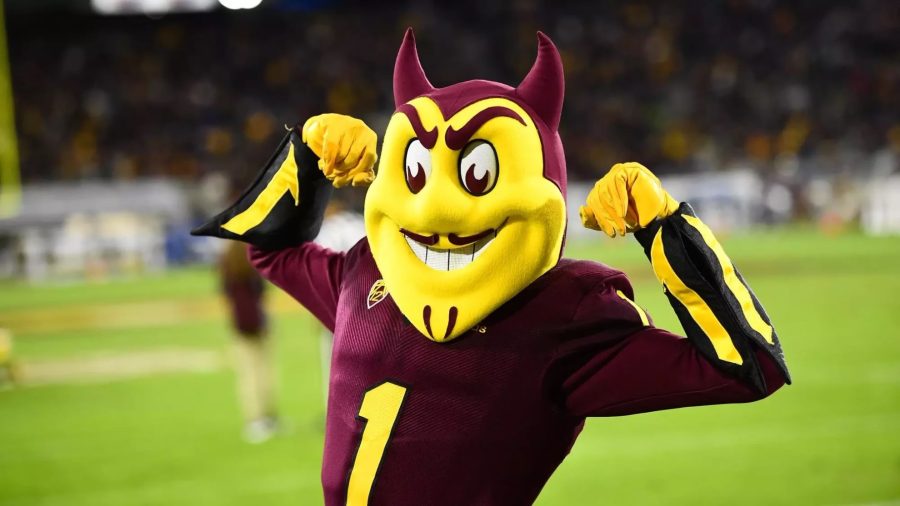
Arizona State teams were not always known as the Sun Devils. Over the years, the programme used several names, including the Normals, Owls and Bulldogs.
However the Sun Devils nickname was adopted in 1946.
The inspiration is generally linked to Arizona’s desert environment and the sight of a dust devil – a small whirlwind that forms in hot, dry conditions. Track coach Donn Kinzle is credited with helping inspire the name after seeing a dust devil while running near the Salt River. Put to a vote, Students voted overwhelmingly in favour of replacing the Bulldogs nickname with Sun Devils.
The famous Sparky mascot followed soon afterwards. Former Disney artist Berk Anthony designed Sparky, the pitchfork-carrying devil that became one of the most recognisable mascots in college sport.
THE GOLDEN YEARS - THE FRANK KUSH ERA
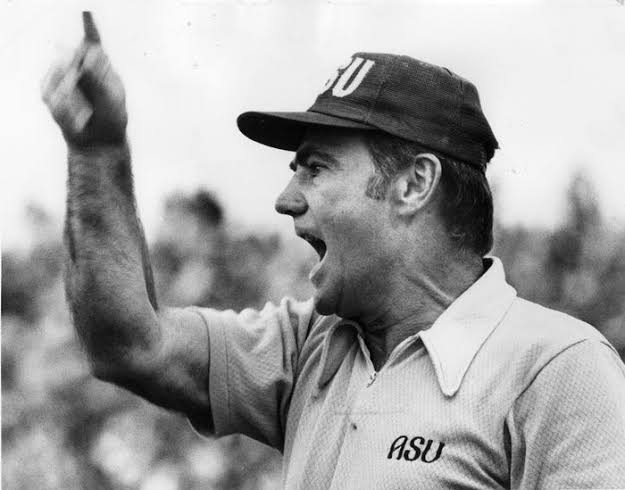
THE FRANK KUSH ERA
The most important coach in Arizona State football history is Frank Kush.
Kush became head coach in 1958 and remained in charge until 1979. His record at Arizona State was 176–54–1.
Under Kush, Arizona State became one of the strongest football programmes in the western United States. He won nine conference championships and produced several nationally ranked teams.
THE 1970 TEAM
Arizona State went undefeated in 1970, finishing 12–0.
The Sun Devils completed the season by defeating North Carolina 48–26 in the Peach Bowl.
It was one of the seasons that established Arizona State as a genuine national football programme.
THE 1975 TEAM
The 1975 Arizona State team is widely regarded as one of the greatest in school history.
The Sun Devils finished the season 12–0.
They defeated Nebraska 17–14 in the Fiesta Bowl.
Arizona State finished No. 2 in the national rankings.
The team did not win the recognised national championship, but the 1975 season remains one of the programme’s greatest achievements.
JOINING THE PAC-10
Arizona State had previously dominated the Western Athletic Conference.
The success of the Frank Kush era helped Arizona State move into the Pacific-10 Conference in 1978.
That move put the Sun Devils into a league alongside programmes such as USC, UCLA, Washington and Stanford.
THE 80'S & 90'S - THE SUCCESS CONTINUES
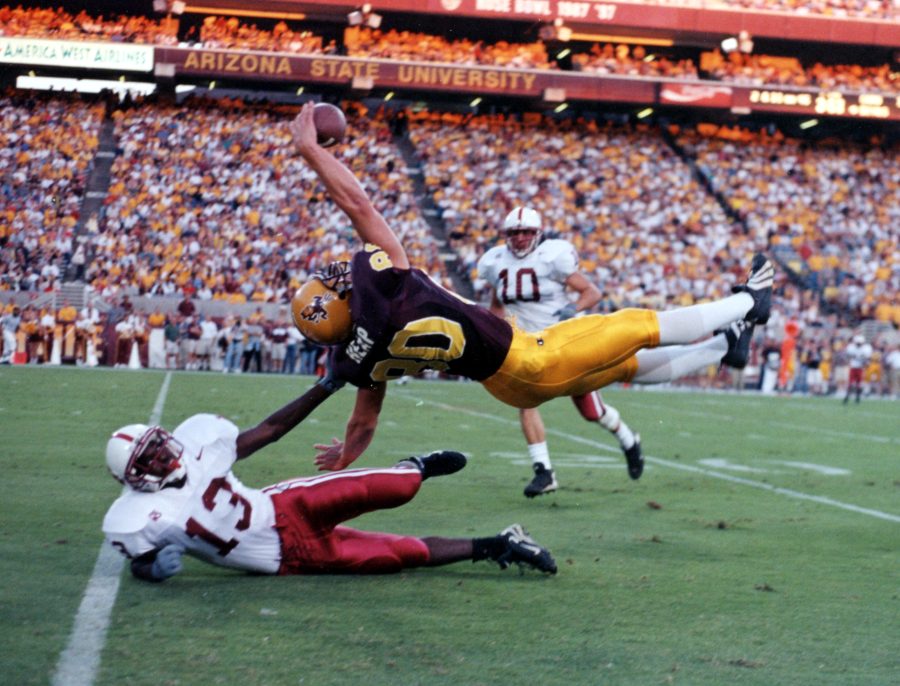
THE 1986 TEAM AND ROSE BOWL
Under head coach John Cooper, Arizona State won the Pac-10 championship in 1986.
The Sun Devils reached their first Rose Bowl.
Arizona State defeated Michigan 22–15 in the Rose Bowl on January 1, 1987.
It was one of the landmark victories in programme history.
THE 1996 TEAM
The 1996 Arizona State team is one of the most famous in school history.
The Sun Devils went 11–0 during the regular season under head coach Bruce Snyder.
One of the defining victories came against Nebraska.
Nebraska entered the game as the two-time defending national champion and the No. 1 team in the country.
Arizona State defeated Nebraska 19–0.
The Sun Devils went on to win the Pac-10 and reach the Rose Bowl.
THE 1997 ROSE BOWL
Arizona State faced Ohio State in the Rose Bowl following the 1996 regular season.
Late in the fourth quarter, quarterback Jake Plummer ran for a touchdown to give Arizona State the lead.
At that moment, the Sun Devils appeared to be on the verge of completing an undefeated season and potentially winning a national championship.
Ohio State responded with a late touchdown.
Ohio State won 20–17.
Arizona State finished the season 11–1 and ranked No. 4 nationally.
GREAT SUNDEVILS IN HISTORY

The Sun Devils have consistently produced not just great college football players but NFL players and at least one Nation Hero.
JAKE PLUMMER
Jake “The Snake” Plummer is one of the most popular players in Arizona State history.
He was the quarterback of the 1996 team that went undefeated during the regular season. Plummer finished third in the 1996 Heisman Trophy voting.
He became known for his improvisational style and ability to make plays outside the normal structure of the offence. Plummer later enjoyed a long NFL career with the Arizona Cardinals and Denver Broncos.
PAT TILLMAN
Pat Tillman is one of the most significant figures in Arizona State history.
Tillman played linebacker for Arizona State and was a key member of the 1996 team. In 1997, he was named Pac-10 Defensive Player of the Year.
The Arizona Cardinals selected Tillman in the seventh round of the 1998 NFL Draft and converted him to safety.
After four seasons in the NFL, Tillman walked away from professional football and enlisted in the United States Army following the September 11 attacks. He became an Army Ranger. Tragically Tillman was killed in Afghanistan in 2004.
Arizona State has retired his No. 42 jersey. His legacy remains an important part of the identity and culture surrounding Sun Devil football.
TERRELL SUGGS
Terrell Suggs produced one of the greatest individual seasons in Arizona State history in 2002.
Suggs was one of the most dominant defensive players in college football.
He won the Bronko Nagurski Trophy, Ted Hendricks Award and Lombardi Award.
The Baltimore Ravens selected him with the 10th overall pick in the 2003 NFL Draft.
Suggs went on to become one of the leading defensive players of his NFL generation.
He was named NFL Defensive Player of the Year, selected to seven Pro Bowls and won Super Bowls with Baltimore and Kansas City.
ARIZONA STATE AND THE PRO FOOTBALL HALL OF FAME
Arizona State has produced five members of the Pro Football Hall of Fame.
They are:
- Charley Taylor
- John Henry Johnson
- Mike Haynes
- Curley Culp
- Randall McDaniel
CHARLEY TAYLOR
Charley Taylor starred at Arizona State before becoming one of the greatest players in Washington NFL history.
He played running back and wide receiver during his professional career.
Taylor was inducted into the Pro Football Hall of Fame.
JOHN HENRY JOHNSON
John Henry Johnson played running back at Arizona State in the early 1950s.
He went on to enjoy a long professional career and was selected to four Pro Bowls.
Johnson was later inducted into the Pro Football Hall of Fame.
MIKE HAYNES
Mike Haynes was an outstanding defensive back at Arizona State.
He became one of the greatest cornerbacks in NFL history.
Haynes played for the New England Patriots and Los Angeles Raiders.
He was selected to nine Pro Bowls and was inducted into the Pro Football Hall of Fame.
CURLEY CULP
Curley Culp was a standout defensive lineman at Arizona State.
He was also an elite collegiate wrestler.
Culp went on to play in the NFL for teams including the Kansas City Chiefs and Houston Oilers.
He was part of the Chiefs team that won Super Bowl IV.
Culp was later inducted into the Pro Football Hall of Fame.
RANDALL MCDANIEL
Randall McDaniel was an outstanding offensive lineman at Arizona State.
He became one of the greatest guards in NFL history.
McDaniel played primarily for the Minnesota Vikings.
He was selected to 12 consecutive Pro Bowls.
McDaniel was inducted into the Pro Football Hall of Fame.
DARREN WOODSON
Darren Woodson played at Arizona State before becoming one of the most successful defensive backs in Dallas Cowboys history.
Woodson won three Super Bowls with Dallas.
He developed into one of the NFL’s leading safeties during the Cowboys dynasty of the 1990s.
ERIC ALLEN
Eric Allen was an outstanding defensive back at Arizona State.
He went on to become a six-time Pro Bowl cornerback in the NFL.
Allen played for the Philadelphia Eagles, New Orleans Saints and Oakland Raiders.
DANNY WHITE
Danny White was one of Arizona State’s leading quarterbacks during the 1970s.
He later became the starting quarterback of the Dallas Cowboys.
White was also unusual in that he was both a quarterback and punter during his professional career.
JOHN JEFFERSON
John Jefferson was one of the most exciting receivers in Arizona State history.
He went on to enjoy an outstanding NFL career, particularly with the San Diego Chargers.
Jefferson became one of the NFL’s leading receivers during the early part of his professional career.
BE A PART OF COLLEGE FOOTBALL HISTORY
Tickets to watch the Sun Devils against the Jayhawks in the inaugural Union Jack Classic on Saturday September 19 can be purchased now via the Union Jack Classic website

George Somerville
College Football Writer SEC Expert
George is a long standing fanatic of life and football in the Deep South and writes his weekly column “It’s Only SEC” FOR THE TOUCHDOWN. HE IS ALSO CO-HOST OF THE COLLEGE CHAPS PODCAST , THE UK’S FIRST AND ORIGINA PODCAST DEDICATED SOLELY TO THE COLLEGE GAME.