
Old Ironsides: The Lost Trophy Behind College Football’s Tri-State Rivalry
By Peter Mann
As the new college football season gets underway, we start a new series of articles here at The Touchdown; a contributor over the past three years, with articles covering the game in England, Europe, college football, and the NFL alike, Peter Mann now takes on the moniker of ‘The Touchdown History Buff.’
The first in a new rivalries series looks at a brief history of OLD IRONSIDES, the tri-state championship trophy contested among the Penn State Nittany Lions, Pittsburgh Panthers, and West Virginia Mountaineers.
Although the rivalry between this trio of college programs dates back to the late 1800s, the Old Ironsides trophy itself was only contested between 1951 and 1984, before it went ‘missing’ whilst in Penn State’s possession.
Founded within a couple of years of each other, the first meeting involving two of the three would see Penn State inflict a 32-0 shutout victory over Pittsburgh in November 1893, in what was the first game to be played at Old Beaver Field, and they went on to win the first six meetings between the two.
The first time in which Pittsburgh and West Virginia faced off came just shy of two years later, the Mountaineers claiming a low-scoring, 8-0 success, in October 1895, whilst the first collision between Penn State and West Virginia was in 1904, and another shut-out success, 34-0 – the first of five successive shut-outs in which Penn State won, before playing a tied, 13-13 game, at Yankee Stadium in 1923.
From those early meetings in the late 1800s, through to the first contesting of Old Ironsides in 1951, the meetings between the Lions, Panthers, and Mountaineers were shown as being a district championship, which would see the Lions claim 24, and the Panthers 12.
As for the Mountaineers, they only claimed two districts, in 1922 and 1928, the same number as they did with only Old Ironsides, in 1953 and 1984.
Jock Sutherland’s sleek Panthers of the roaring twenties and thirties
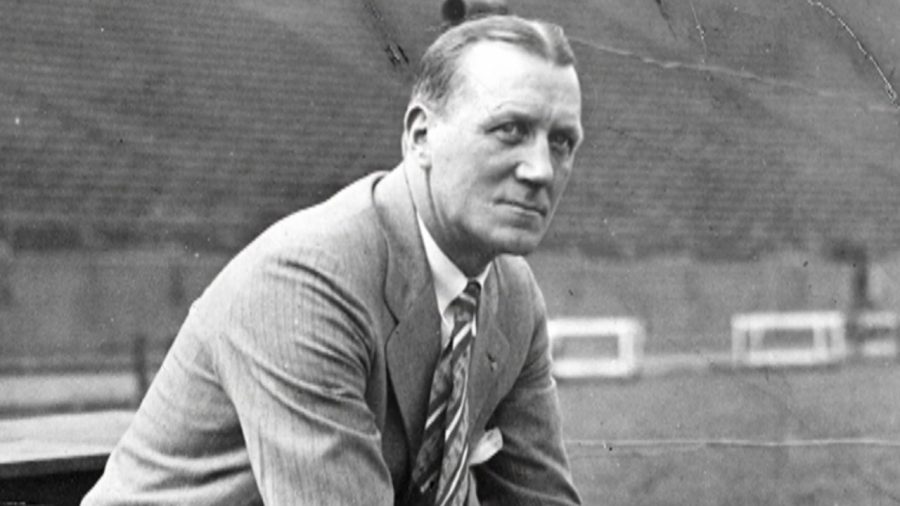
The Pittsburgh Panthers were founded in the late 1880s, with football first being played there in the fall of 1889, under the auspices of its early name, the Western University of Pennsylvania.
Since their founding, the Panthers are on their 37th head coach, with Pat Narduzzi holding the reins since 2014; they’ve had nine claimed and eight unclaimed National Championship successes, those early 1900s being a successful period for the program.
Throughout the 1920s and 1930s, Pittsburgh Panthers were led from the sidelines by Jock Sutherland, Head Coach 1924-38, leading them to eleven district championship successes.
Of those successes, Sutherland’s Panthers went four-in-a-row on two separate occasions, 1924-27 and 1935-38, alongside a hat-trick of district successes between 1929-31; they also claimed five National Championships during his reign.
With a name like Jock Sutherland, you’d be right in thinking he was Scottish, hailing from Coupar Angus, in the Perth and Kinross region, with his college football career beginning with the Panthers as an end (1915-17), then a season with the Massillon Tigers (1919).
Sutherland’s last season playing for the Panthers was their legendary undefeated season in which they were nicknamed ‘The Fighting Dentists,’ under then Head Coach Pop Warner – why ‘The Fighting Dentists?’ Well, that’s down to the fact that there would be times that every position was filled by dental students, Sutherland included.
From his brief tenure coaching the Tigers, Sutherland would be seen to begin his coaching career officially at Lafayette Leopards (1919-23), before his lengthy spell at the helm of the Panthers, and in the National Football League with the Brooklyn Dodgers (1940-41), then Pittsburgh Steelers (1946-47), serving in the US Navy during World War Two.
Throughout his time in charge of the Panthers, Sutherland’s program also competed in four Rose Bowls, losing in 1928, 1930, and 1933 (to Stanford and USC twice), before finally winning the Bowl itself in 1937, courtesy of a 21-0 shutout victory against the Washington Huskies.
Back in the district championships, meanwhile, Sutherland’s Panthers would be seen to dominate the football field, with only a couple of West Virginia Mountaineers insertions putting up any kind of challenge.
The Panthers’ dominance of 1927 stands out due to the shut-out successes inflicted upon both Penn State (30-0) and West Virginia (40-0), and in 1938, when they repeated the feat against Penn State (26-0) and West Virginia (19-0).
Early in the ’27 season (8 October), Pittsburgh halfback and captain, Gilbert ‘Gibby’ Welch, would be seen to return a punt for some 105yds, for a touchdown score against the Mountaineers – it was one of several highlight reels Welch put up during that campaign.
Other Welch highlights in ’27 were an 84yd TD from the opening kick-off against Nebraska, adding a 71yd score in the second half of the same game; whilst in the shut-out win over Penn State, the Charleston Gazette lauded his performance saying that Welch; “ripped the Penn State line to shreds, bent the Lion ends almost double with his wide sweeping runs, and kicked and passed in almost uncanny form when necessary.” (25 November 1927)
Fast-forward to the shutout successes of ’38 and a standout player in what was coined a ‘dream backfield’ for Pittsburgh, New York halfback Dick Cassiano, who scored three times in the victory over Penn State.
Cassiano was the only junior on the side that year, and the New York Times rolled out the following: “Pitt bowled over a dazed Penn State football team to win, 26-0, today, with Dick Cassiano, lone junior in the “dream” backfield, racing for three touchdowns.” (19/20 November 1938).
It really was an early era of dominance in this tri-state championship, an early era that was dominated mostly by the Pittsburgh Panthers, before the introduction of the Old Ironsides trophy, which would be presented to victors of this historic triumvirate of programs.
Old Ironsides, the early contests
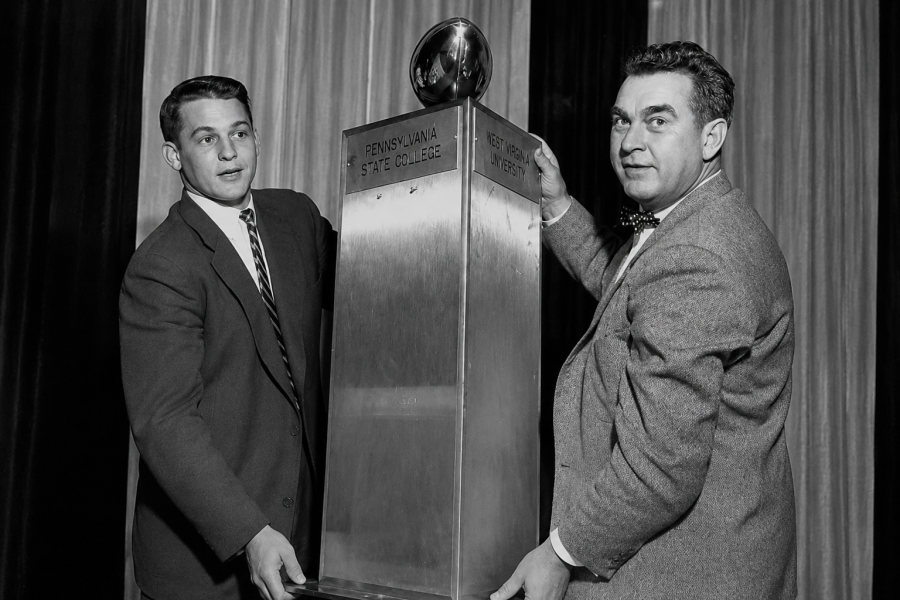
Brought to the fore in the early fifties, Old Ironsides was to be given to the victors of a round-robin series, a trophy which was described by the Pocono Herald, in the mid-sixties, as being “an ugly hunk of steel.’
Introduced by the Pittsburgh Junior Chamber of Commerce, the trophy held three plaques on its triangular base, one for each of the schools named as of that particular time, and was presented to the winning coach, or chosen coach representative; however, the trophy never really caught the eye.
In terms of the media and the supporters who came to watch Penn State, Pittsburgh, and West Virginia, it was seen as being a novelty, with more on its size and weight, and press coverage lessened further afield.
However, a trophy it was, and, before the eventual domination of Penn State, who claimed 21 Old Ironsides trophies outright, those early years were a completely mixed bag of results, including four tied series, between ’51 and ’59.
Over those first nine years, Penn State (1952 and 1958) and Pittsburgh (1951 and 1955) claimed two each, whilst West Virginia won their first of their two Ironsides in 1953, whilst the trophies of 1954, 1956, 1957, and 1959 were shared, with Pittsburgh, having won in ’55, retaining the trophy the following two years.
Throughout the fifties, though, none of the tri-state programs would find themselves dominant: Pittsburgh winning nine games, Penn State with eight successes, and West Virginia managed an impressive seven victories of their own.
During the Old Ironsides era, only three games between this triumvirate were tied, two of those coming in the fifties: a 7-7 score between Penn State and Pittsburgh, on 24 November 1956, and a 14-14 game between West Virginia and Penn State two years later, on 8 November 1958.
For three successive seasons, 1952-54, Penn State inflicted a hat-trick of shut-out successes on Pittsburgh (17-0 twice, 13-0), whilst Pittsburgh did the same to Penn State in 1955 (20-0), whilst West Virginia also added a shut-out success against Pittsburgh (16-0) in that early, 1952 campaign.
As for the highest-scoring contest of the fifties, that was the 53 points put up in the game between Penn State and West Virginia (35-21), on 11 October 1952; things, though, were about to change between the trio, and the Lions roared for the better part of the next quarter century.
Engle and Paterno have the Lions roaring through the sixties, seventies, and into the eighties
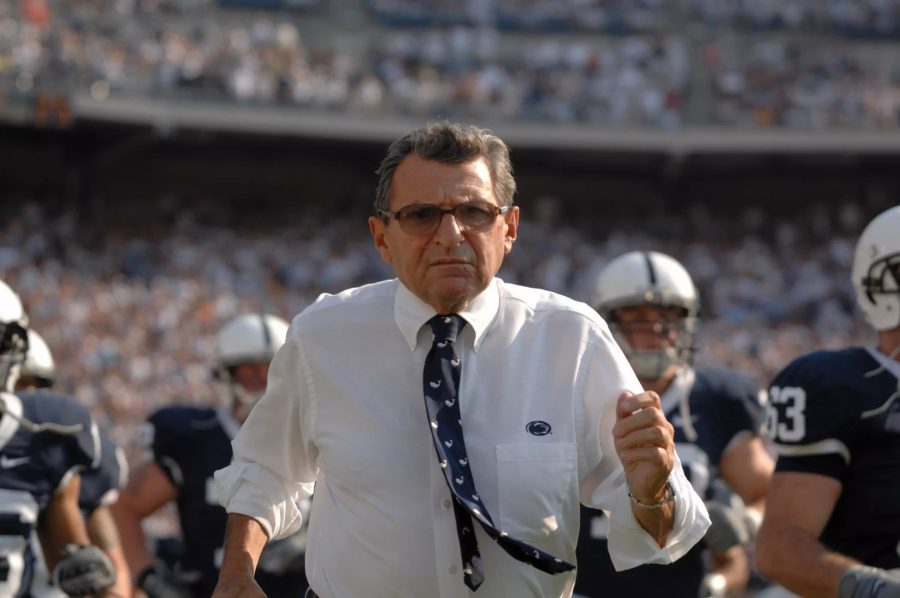
Penn State Nittany Lions first saw the light of day back in the late 1880s, but it was six years prior, in 1881, that the first recorded game was said to have taken place, in a game of what was labelled as ‘American Rugby,’ with Penn claiming a 9-0 victory over the hosts, the University of Lewisburg (Bucknell Bison).
Although their first season came in 1887, Penn State’s first Head Coach was not for another five years, with George Hoskins taking the reins in 1892; there have now been seventeen permanent coaches and two interims, with Matt Campbell the incumbent.
Over the years, the Nittany Lions have claimed two national championships (1982 and 1986), and five unclaimed championships, with Rip Engle (16 seasons) and Joe Paterno (45 seasons), two of the program’s five long-serving head coaches, the others being Hugo Bezdek (12 seasons), Bob Higgins (19 seasons), and James Franklin (12 seasons).
Engle and Paterno are two names who are completely synonymous with the history of Penn State Nittany Lions, between them holding the position of Head Coach from 1950 to as recently as 2011.
Despite a brief playing career, Engle’s coaching prowess, bridging both football and basketball, spanned from 1930 to 1965, and as HC of the Brown Bears for six seasons during the forties, before ruling the Lions from 1950 through to 1965.
Throughout Engle’s tenure at the helm, Penn State claimed Old Ironsides on six occasions, including a hat-trick in the early sixties (1960-62), clean-sweeping tri-state rivals, Pittsburgh and West Virginia, during this period.
Of those successes, the highest scoring came on 25 November 1961, a 73-point game with Pittsburgh, the Lions running out 47-26 victors, whilst their only shut-out success in the early sixties meetings came on 21 November ’64, when they registered a 28-0 result, again against Pittsburgh.
After fifteen seasons at the helm, Engle stepped aside following the 1965 campaign, and having posted a winning record of 104-48-4, along with back-to-back Liberty Bowl victories (1959 and 1960), and a Gator Bowl (1961) – the 1960 Liberty Bowl success, that was a 41-12 game against Oregon Ducks, at the Philadelphia Municipal Stadium.
Putting up second- and fourth-quarter rampages, 21-0 and 20-0, saw the Lions roar to victory over the Ducks, with running back Dick Hoak the MVP following two touchdown scores, and Henry Opperman successful with four kicks.
Paterno, meanwhile, took over from Engle in ’66, having been Engle’s assistant for the entirety, and was his quarterback during the back end of the forties at Brown, and spent the next 45 seasons at the helm.
During his tenure at Penn State, he led them to two national championships (1982 and 1986) and three Big Ten titles (1994, 2005, and 2009), alongside more than a dozen Coach of the Year awards, posting an eventual winning record of 409-136-3.
Where Old Ironsides was concerned, and that tri-state rivalry, Paterno’s Penn State went on to be victorious on some fifteen occasions, including ten straight between 1966 and 1975, whitewashing Pittsburgh and West Virginia along the way, having them fight amongst themselves for the crumbs.
Against Pittsburgh, Penn State registered 25-or-more points in the first nine meetings, surpassing 50-points twice; meanwhile, against West Virginia, all ten seasons would see 20+ points scored, as well as a pair of shut-out victories in 1969 and 1975.
Always climbing mountains; the West Virigina Mountaineers story
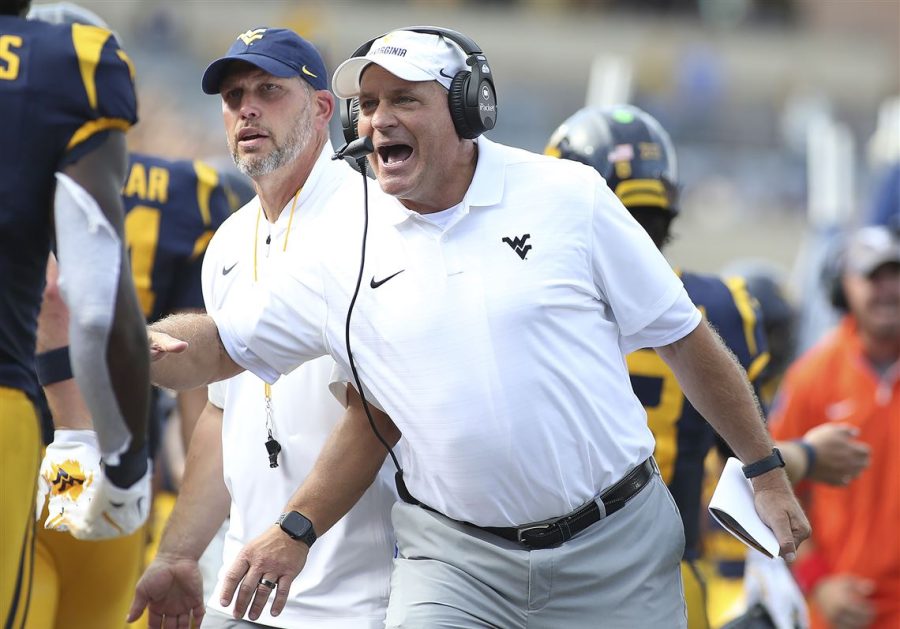
Flirtations with success, without actually crossing the line to greatness, the West Virginia Mountaineers have themselves a long, yet varied history; it’s a history which has seen them claim eight Southern Conference championships and seven Big East championships, the last of which overall arrived fifteen years ago.
The 1950s and 1960s, though, were heady times for a program that first saw the light of day back in 1891, and, even then, it was a disastrous beginning, falling to a 72-0 shutout loss to Washington & Jefferson Presidents, on a converted cow pasture.
Business though, it picked up as 1800s passed into 1900s and, in more recent years, there’s even been three bowl successes, winning the Cactus Bowl (2015), Liberty Bowl (2020) and Duke’s Mayo Bowl (2023), with current head coach, Rich Rodriguez, in his second spell at the helm, the third to do so after Rat Rodgers (1925-30, 1943-45) and Bill Kern (1940-42, 1946-47).
Don Nehlen holds the record for the longest spell in charge of the Mountaineers, holding the post for two decades between 1980 and 2000, joining them after a winning-record run with the Bowling Green Falcons in the late sixties and early seventies.
Whilst leading the Mountaineers, Nehlen saw them compete in thirteen bowl games, winning four, including the Music City Bowl in his last season, 2000, as his charges put on a show with a 49-38 success against Ole Miss Rebels – appearing for the Rebels in that game was a certain quarterback, Eli Manning (New York Giants, 2004-19).
Where the Old Ironsides is concerned, however, any joy was even harder to come by, with only two successes in the district championships era, in 1922 under Clarence Spears’ guidance, and six years later, in 1928, with Ira Rodgers at the helm.
As for the Old Ironsides trophy itself, again the Mountaineers bowed down to the dominance of Penn State and Pittsburgh, succeeding only in 1953 (the third edition) and again in 1984 (the last).
In ’53, victory was taken over Pittsburgh in their season opener, winning 17-7 in Pittsburgh on 26 September, whilst Penn State were felled on gameday six, when a blocked punt saw them claim a 20-19 success on Halloween (31 October).
Those victories were part of a 7-0 start to the season, going on to finish 8-1, before losing the Sugar Bowl to Georgia Tech Yellow Jackets – the Mountaineers’ HC was Ohio-native Art Lewis, who played professionally for the New York Giants and the Cleveland Rams.
Meanwhile, a little over thirty years later, and the last time in which Old Ironsides was contested, the Mountaineers were successful once again, under the aforementioned Don Nehlen.
Despite losing four games during the regular season, the Mountaineers finished with a winning record of 7-4, which saw them both contest and win the Bluebonnet Bowl, putting on a 31-14 victory over TCU Horned Frogs at the Houston Aerodrome.
Their enjoyment was also added to by lifting Old Ironsides, this following a 28-10 victory over Pittsburgh, on 29 September (games between these two are also known as the Backyard Brawl rivalry, which encompasses football, basketball, baseball, and soccer meetings).
A month later, Nehlen’s program also saw off Penn State on 27 October, winning live on ESPN and in front of close to 65,000 spectators in Morgantown; however, the trophy itself was not presented.
Penn State, having won the trophy in the previous three years (taking their overall tally to 21), lost the trophy, with reports stating that any searches of their offices and museum had come up fruitless.
There have been no searches since, and the whereabouts of this “ugly hunk of steel” is said to be unknown.
Modern-day battles between Lions, Panthers, and Mountaineers
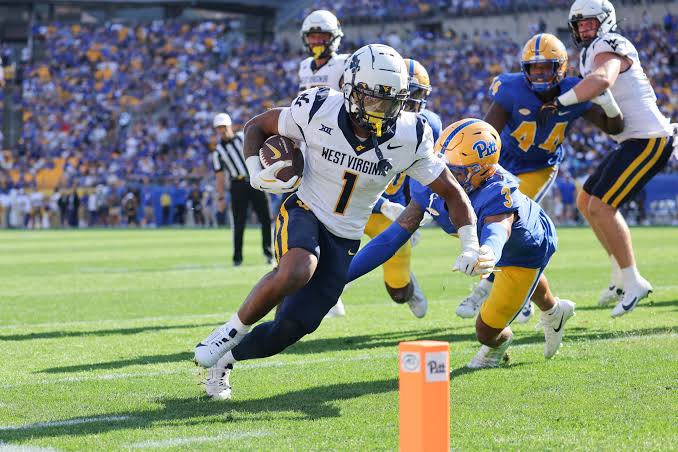
This brings us to the present day; with Old Ironsides consigned to the history pile in the mid-eighties, this trio still meet each other regularly, with Pittsburgh – West Virginia the most frequent.
Penn State – West Virginia has met ten times since the mid-eighties, with the Lions emerging victorious on nine occasions, the last of which was a 34-12 success for Penn State in August 2024.
Two shutouts were registered back-to-back in 1985 and 1986, whilst there was also a 51-6 victory in 1991; West Virginia’s sole success, meanwhile, was 51-30, back in 1988 (Penn State leads the series 50-9-2).
There have also been a dozen meetings between Penn State and Pittsburgh, the Lions again coming out on top with ten victories, the last of which was a 17-10 win for Penn State back in September 2019.
Despite Penn State’s success, which includes a 57-13 win in 1992 and a 51-6 rout in 2018, Pittsburgh has the most recent shutout on their ledger, winning 12-0 when the two met in 2000 (Penn State leads series 53-43-4).
Then there’s West Virginia; they’ve met Pittsburgh a dozen times since 2004, with the Mountaineers winning seven to Panthers five in the past twenty-five years, including the meeting between these teams in September last year, with West Virginia claiming a 31-24 victory.
Following years of Pittsburgh dominance between 1910 and the mid-fifties, and the late seventies and early eighties, the Mountaineers have turned this series on its head since the late eighties, winning eighteen, including seven of their last dozen.
Having won five in a row in the early-mid nineties, the Mountaineers fans have enjoyed five in the last seven, including a 35-10 win in 2010 and a 31-24 overtime win last time, avenging the 38-34, four-point loss the previous year. The two programs have met four times in the past four years, with two wins each (Pittsburgh leads the series overall, 63-42-3).

Peter Mann
COLLEGE FOOTBALL ANALYST
PETER IS A LIFELONG SPORTS FAN, JOURNALIST AND AUTHOR BASED IN COUNTY DURHAM. HE HAS FOLLOWED THE NFL AND THE RAIDERS SINCE THE 1980s, AND LOVES BOTH SPORTS AND FAMILY HISTORY. PETER HAS A DEGREE IN SPORT & EXERCISE PSYCHOLOGY, AND CAN BE FOUND ON TWITTER @petermannwriter.