
NCAA Division II Football Championship: A History of Champions and Dynasties
By Peter Mann
Having recently looked at a potted history of Division III, attention now turns to that of college football’s NCAA Division II championship, one of Bison and Lions, Bears and Bulldogs, among numerous others; it is a championship that, like Division III, has been running since the early seventies.
Recent years have seen dominance by the Ferris State Bulldogs, from Big Rapids, Michigan, with Tony Annese’s program having lifted four of the last five championships, taking them from contenders to champions in his thirteen years at the helm.
Before that, however, and back to the seventies, the championship was lifted by nine different programs in its first nine seasons, Delaware’s Fightin’ Blue Hens twice being runners-up before finally claiming the big one themselves.
The 1980s would belong to North Dakota State Bison, whilst the 1990s saw the first three-peat, that coming via North Alabama Lions; the new millennium would again see a change in championship pennants, Grand Valley State Lakers and Valdosta State Blazers claiming four apiece, and Northwest Missouri Bearcats, who won their first in 1998, becoming the first program to six.
In the Beginning, Nine in Nine
In taking over from the NCAA College Division, which ran throughout the 1960s, and saw that of North Dakota State Bison win five bowls (1965, 1968, 1969, 1970, 1972), Delaware Fightin’ Blue Hens four (1968, 1969, 1970, 1971), and Tennessee State Tigers three (1970, 1971, 1972), the conference realignment changed the face of college football.
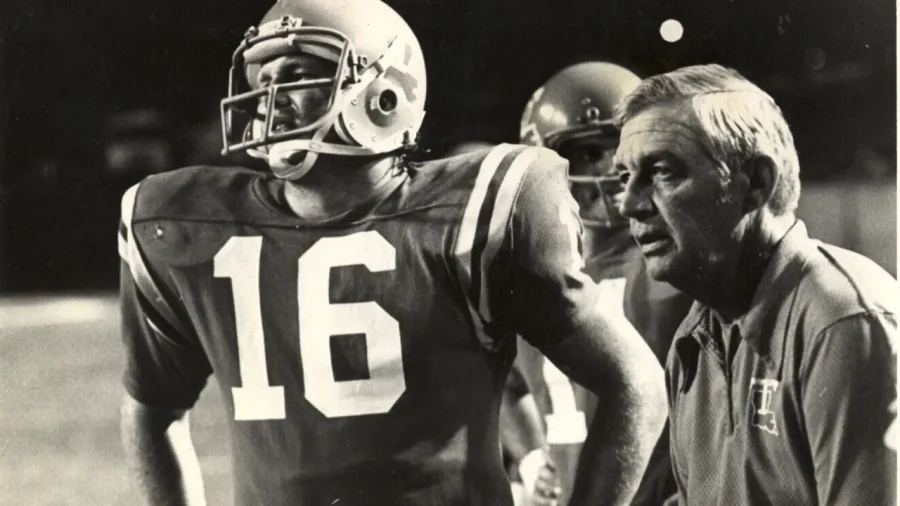
Between 1973 and 1981, nine different programs would be crowned Division II National champions, beginning with, in ’73, Maxie Lambright’s Louisiana Tech Bulldogs when, after having lost their season opener at Eastern Michigan Hurons, went on a twelve-game winning streak, finishing the season 12-1, with a 34-0 shutout success over Western Kentucky Hilltoppers at the final dance.
Over the ensuing years, championships would then go to Central Michigan Chippewas (1974), Northern Michigan Wildcats (1975), Montana State Bobcats (1976), and Lehigh Engineers (1977), the latter being the second shutout victory, as John Whitehead’s Engineers won 33-0 over Jacksonville State Gamecocks.
The Eastern Illinois Panthers edged a tight game, 10-9, with the Delaware Fightin’ Blue Hens in ’78; Delaware finally succeeded, at the third time of asking, a year later. Tubby Raymond’s battle-hardened program defeated the Youngstown State Penguins, 38-21.
California Polytechnic (Cal Poly) Mustangs lifted the championship in 1980, whilst the ninth title in nine was claimed by Southwest Texas State Bobcats, winning 42-13 against North Dakota State Bison in 1981.
Of those successes, the Panthers’ road to glory, in 1978, was done in Head Coach Darrell Mudra’s first season at the helm, his offensive coordinator, in his only season there, Mike Shanahan, who went on to have a successful career in the NFL with Denver Broncos, Los Angeles Raiders, San Francisco 49ers, and Washington Redskins, between 1984 and 2013, winning two Super Bowl championships along the way.
Delaware’s Tubby Raymond, meanwhile, twelve months later, was in his fourteenth season with the Fightin’ Blue Hens, in ’79; having played and coached both college football and college baseball, he arrived in Delaware in the mid-fifties, and spent a lifetime with them.
Raymond spent some thirty-six seasons at the helm of Delaware, holding the post from 1966 through to 2001, and seeing action in the Middle Atlantic Conference, NCAA College Division/NCAA Division II Independent, NCAA Division I-AA Independent, Yankee Conference, and the Atlantic 10 Conference divisions.
During that near four-decade tenure, Raymond would surprisingly oversee just the one undefeated campaign, going 10-0 back in 1972; they did register a 13-1 season in 1979, and a trio of 12-1 seasons (1982, 1997, 2000), as he posted an overall coaching record of 300-119-3.
Dakota and Alabama Rule the Eighties and Nineties
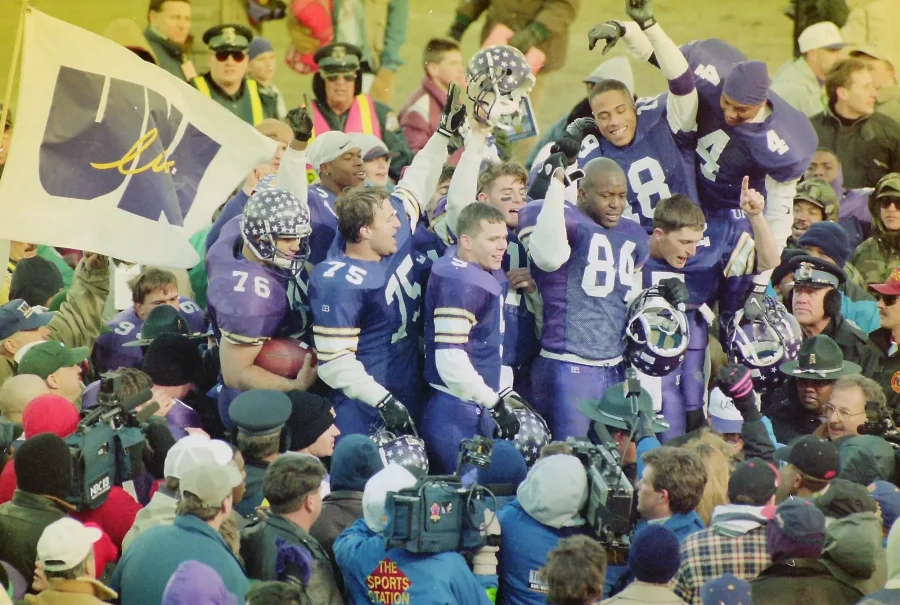
Throughout the 1980s and 1990s, the NCAA Division II championship was clasped in the firm grip of primarily two college programs: North Dakota State Bison, who won five championships and were runners-up twice, and North Alabama Lions, who became the first college to three-peat, winning a hat-trick of championships themselves in the mid-nineties.
During the Bison’s long reign of terror in the eighties, they were guided by three different Head Coaches: first was Don Morton (1979-1984), then briefly Earle Solomonson (1985-1986), followed by Rocky Hager (1987-1996), the trio putting together several historic winning streaks.
On seven occasions during their reign, a dynasty of terror that saw them win championships in 1983, 1985, 1986, 1988, and 1990, and be runners-up in 1981 and 1984, they racked up double-figure winning streaks.
The longest of those seven streaks arrived under Hager’s reign, stretching for 21 games between 1987 and 1989, quickly following up with another 14 games over 1990-1991; surprisingly, neither of those was a record; that came more recently, and also belonged to the Bison, racking up an ultra-impressive 39 games, an FCS record, between 2017 and 2020.
As for the North Alabama Lions, a triumvirate of championships between 1993 and 1995, under the guidance of Bobby Wallace, saw them become the first college program to three-peat in Division II.
During these three years, Wallace’s Lions only lost once, at Youngstown State Penguins, on 8 October 1994 (17-14, either side of which they’d put on streaks of 18 (since the start of the ’93 season) and 23 (until the end of ’95), with two of those championship-winning seasons seeing them undefeated, 14-0.
Against the IUP Crimson Hawks, in December ’93, the Lions saw off the challenge with a 41-34 victory, following it up by defeating Texas A&M-Kingsville Javelinas 16-10 in ’94, and finally Pittsburgh State Gorillas 27-7 in ’95.
For Wallace, it was just reward for hard work over what was a decade-long tenure, running between 1988 and 1997, before taking in spells at Temple Owls and West Alabama Tigers over the next thirteen seasons.
Wallace returned to North Alabama in 2012, the program still residing in the Gulf South Conference, leading them into the postseason playoffs in four of his five seasons back at the helm, ending as runners-up in 2016, his last season, losing 29-3 to Northwest Missouri State Bearcats.
Wallace’s tenure at the helm of the Lions certainly leads nicely into the new millennium, his tenure covering four decades, between 1988 and 2016.
Lakers, Blazers, and Bearcats Lead the Revolution
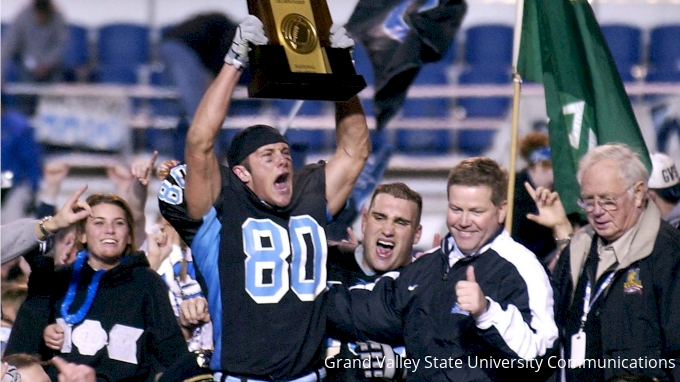
Since the turn of the millennium, and up to the pandemic of 2020, eight different programs have lifted the Division II championship, with Delta State Statesmen, North Dakota Fighting Sioux and Grand Valley State Lakers winning those first three, the latter going on to claim four in five whilst also being runners-up on two further occasions.
Under Brian Kelly, Grand Valley State went back-to-back in 2002 and 2003, seeing off the challenges of Valdosta State Blazers (31-24) and North Dakota Fighting Sioux (10-3), winning twenty-eight of their twenty-nine games, the only loss, a 34-20 reverse at the hands of Saginaw Valley State Cardinals, in the ‘Battle of the Valleys’ on 18 October ‘2003.
That defeat to the Cardinals was avenged a little over a month later, 10-3 in the Division II quarter-finals, before seeing off the Javelinas 44-7 in the semis, and the Fighting Sioux in the final itself.
Chuck Martin then replicated Brian Kelly’s success with the Lakers by going back-to-back in 2006 and 2007, bettering it by going undefeated over twenty-eight games, and defeating the unlucky Bearcats in both, 21-17 and 17-14 respectively.
Valdosta State Blazers claimed the first of their four championships in 2004, and their last in 2018, whilst Northwest Missouri Bearcats would take the first of their six titles with back-to-back successes in the late nineties.
The Bearcats have had an up-and-down relationship with the Division II championship, from their first two successes in the late nineties, through to their sixth victory in 2016; they’ve appeared in ten finals, losing four consecutively between 2005-08.
Those two successes in the late nineties saw Mel Tjeerdsma’s charges impressively brush aside, on both occasions, Carson-Newman Eagles; if 1998 showed their skill in a 24-6 victory, 1999 showed grit and determination in a contest that went to overtime, saw 110-points registered, and the Bearcats edging a stunning 58-52 contest.
A third crown was added in 2009, losing the stigma of the four successive losses in the previous four years, done so with three differing head coaches (Chuck Martin, David Dean and Bob Neilson), before Tjeerdsma returned to turn the tide, doing so with a 30-23 revenge victory over the Lakers.
Championship number four was added in 2013, a 43-28 win over Lenoir-Rhyne Bears, whilst five and six came back-to-back in 2015 and 2016, 34-7 against Shepherd Rams and 29-3 over North Alabama Lions, Adam Dorel in the hot-seat for that trio before going on to spend time with Abilene Christian Wildcats, and Central Oklahoma Bronchos.
A fourth championship went to Valdosta State Blazers in 2018, Kerwin Bell leading them to a dramatic, two-point win over Ferris State Bulldogs (49-37), those runners-up doing as others had done before them, turning defeat to victory in the championship game.
In addition to those multi-time champions, there’s also been a handful of one-season wonders as well, notably the 2014 CSU Pueblo ThunderWolves, the 2017 Texas A&M Commerce Lions, and 2019 West Florida Argonauts – the ThunderWolves suffered one defeat in a 14-1 campaign and shut-out Minnesota State Mavericks, the Texas Lions did the same en-route to defeating the Argonauts in a 64-point game, and the Argonauts themselves returned two years later in a 13-2 season to defeat the Mavericks in a mouthwatering, 88-point collision.
Bulldogs are the Modern-Day Dynasty
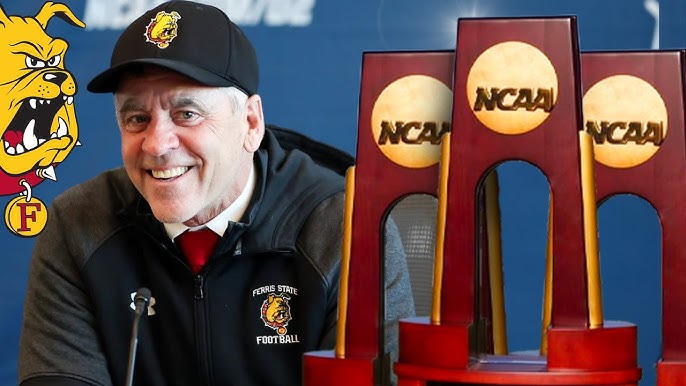
Over the past five years, Tony Annese’s Ferris State Bulldogs, from Big Rapids, Michigan, have had the Division II Championship locked in, winning in 2021, 2022, 2024 and 2025.
The Annese Dynasty at Ferris State sees Head Coach Tony and son Steve, his offensive coordinator, running the ship for fourteen years now, the duo having been there since 2012. In addition to the father-and-son combination has been the addition of Tony Annese Sr.’s nephew, Tony Annese II, as defensive coordinator, reaffirming the family affair in Big Rapids.
Having narrowly come up short in the aforementioned 2018 Division II Championship game against Valdosta State, the Bulldogs regrouped and, following a return to action after the COVID pandemic, dominated, avenging their 2018 loss not once in 2021, but twice in 2024; they also avenged their 2023 loss to Harding in last season’s decider as well.
The last seven championship games have been held at McKinney Stadium, Texas, and it’s beginning to feel like a home-from-home for Annese et al, putting over a hundred combined points past the Blazers in 2021 (58-17) and 2024 (49-14), and conceding just thirty-one.
Colorado Mines Orediggers would be on the receiving end of defeats to the Bulldogs in 2022 (41-14) and Paul Simmons’ Harding Bisons in 2023 (38-7) – and who knows, if history continues to repeat itself, those Orediggers could well lift the Division II championship themselves soon enough; others have done so.
Back to the Bulldogs though, and the past two seasons have seen their dominance continue, defeating the Blazers again in 2024 (49-14), in what was the lowest attended final, 3,228, in the game’s history (the 2021 final saw just 3,933 attend).
Last time out however, over 10,500 were in attendance as Ferris State and Harding shared 63-points, the Bulldogs putting on an impressive, 16-0 undefeated season that culminated in high-scoring playoff victories over Northwood Timberwolves (65-14), Ashland Eagles (56-24), Minnesota State Mavericks (52-29), and Newberry Wolves (49-17), all at their Top Taggart Field home, in Big Rapids.
As the top two sides collided last year, Harding #2 and Ferris State #1, perhaps the biggest surprise was that neither side registered a single point in the fourth quarter of a game which the defending champions won 42-21, they having blitzed the Bisons in the first and third quarters, quarterbacks Wyatt Bower registering 177yds, 2TDs (pass), 38yds, 3TDs (rush), and Chase Carter adding a rushing score of his own for the champions – Bower connected with Carson Gulker and wide receiver Cam Underwood.
They’ll now hope to become only the second program to three-peat, equaling that of the North Alabama Lions in the mid-nineties, and in doing so, add a fifth championship to their name.

PETER MANN
NFL ANALYST
PETER IS A LIFELONG SPORTS FAN, JOURNALIST AND AUTHOR BASED IN COUNTY DURHAM. HE HAS FOLLOWED THE NFL AND THE RAIDERS SINCE THE 1980s, AND LOVES BOTH SPORTS AND FAMILY HISTORY. PETER HAS A DEGREE IN SPORT & EXERCISE PSYCHOLOGY, AND CAN BE FOUND ON TWITTER @petermannwriter