
Noah Short: Path To The NFL Draft
By Simon Carroll
Accepting a scholarship offer from a military academy isn’t for every student athlete. It requires exceptional character, discipline, selfless service and leadership potential. Very few eighteen-year-olds can claim to hold all those traits, and the ones that do have to be willing to embrace sacrifice to become the best version of themselves.
West coast born and raised, Noah Short had dreams of becoming a star in the Pac-12. But fate took him to West Point, and he’s never looked back. And now, he’s on the cusp of achieving a lifelong dream. The Army wide receiver sat down with Simon Carroll to discuss his path to the NFL Draft:
Early Beginnings
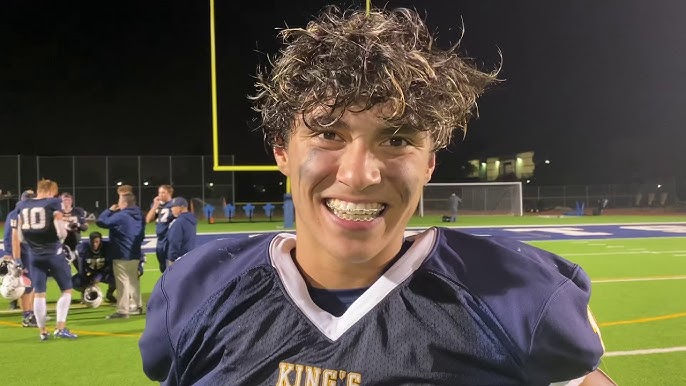
Tom Brady. Davante Adams. Marshawn Lynch; the Bay Area in California has been called home by some of the greatest ever to put on a pair of cleats. It’s a region incomparable when it comes to football glory, with the likes of Jerry Rice and Joe Montana leading the San Francisco 49ers to a quintet of Super Bowls in the 80’s and 90’s. Born and raised in San Jose, Noah Short began his love affair with the game through his family, playing youth football with the Oak Grove South Rebels:
“I was introduced to football by my father and elder brother. My dad, Michael, he’s always been my coach growing up, and Elijah was four years older than me, so my first memories were me running around practices like the little mascot, jumping into drills! But as I got older the pair of them helped instil in me hard work and 100% commitment. That sibling competition definitely helped me out along the way.”
Those early years was where Noah and Elijah departed; the elder heading to De La Salle high school in Concord, whilst the younger Short found himself at The King’s Academy (TKA) in Sunnyvale. It was the perfect playground for Noah to hone his skills:
“It was awesome. The athletic director there, Joe Mayone, he really took us in. And the head coach at the time, Peter Lavorato, was extremely successful at the high school level. The culture there really allowed me to develop as a player and showcase what I could do on the football field.”
Coach Lavorato’s decorated high school resume was well known in California prior to his arrival at TKA. But in five years in Sunnyvale, he managed to transform the Knights into back-to-back Central Coast Section Champions, before retiring after the 2021 season. A two-sport athlete who also enjoyed basketball, Short’s early exposure to the team allowed him to make quite the name for himself on the west coast, leading to a scholarship offer from one of the greatest coaches in the game:
“I played Junior Varsity as a freshman. But it was my sophomore year where things really began to take off. I started as a linebacker on defense, believe it or not – I think I was maybe 170 pounds soaking wet! But our scheme allowed me to be free to go inside the box and attack the perimeter, which helped me show my speed on that side of the ball. And sure enough, that following spring, I started to get some visits from colleges. Mike Leach was up at Washington State at the time, came down and offered me a full ride. I was on cloud nine – I immediately accepted.”
From Wazzu To West Point
Glory to God! So excited to be apart of the West Point Brotherhood#beateverybody🏴☠️⚔️@TKA_Athletics @ArmyWP_Football @CoachTuitele @ArmyFB_Recruit @BrandonHuffman @NorCalPreps pic.twitter.com/UMpO88l41C
— Noah Short (@NoahShort221) September 10, 2020
A west coast kid with the trademark California smile, it was Noah Short’s dream to play in the Pac-12. Back then the conference was one of the most recognisable in the country, a league with a strong regional identity and a handful of programs with National Championship intentions. To be able to play under one of the great offensive minds of the last thirty years – albeit on defense – was a source of great pride to Short. But college football journeys aren’t always the fairytales television makes them out to be, and a coaching change in Pullman would move the goalposts for the young playmaker:
“After committing to Wazzu, my junior year went well, and then senior year, COVID hit. I remember it vividly; I was watching TV at home and the ESPN notification popped up at the bottom of the screen: ‘Mike Leach goes to Mississippi State’. It was like a gut punch. I knew then and there that it wasn’t good news, and when I spoke to the new staff they confirmed my fears; they didn’t have a scholarship for me. My dream was in tatters; I’d gone from playing Pac-12 football to having zero scholarship offers, because I’d shut down my recruiting so early.”
After a decade torching Big 12 defenses with Texas Tech, and eight years in the Pacific Northwest upsetting the Pac-12 powerhouses, the secret about Mike Leach was out. He was headed for the shiny lights of Stark Vegas and the SEC, exposing a young Noah Short to one of the crueller sides of recruiting. The high school star was down but not out; and with help from his support network rebounded to keep his dream of college football alive:
“Coach Lavorato, he saved me. I was grateful for him reaching out to contacts, and even though it was late in the day I started to get some FCS offers. Then the service academies reached out, and eventually the choice for me came down to staying close to home and going to UC Davis, or playing FBS football and heading to West Point. I was so grateful to have options, because I thought I might have to go JUCO for a year or so. It was a blessing from God that he lined up everything.”
For many student-athletes, attending a service academy is ruled out immediately. The days are long, the schedule gruelling. There’s no kid gloves in the Army, Navy or Air Force – it’s tough for young men and women, who are required to grow up quick. But Short’s grandfather served in the Navy, and the family culture was one that embraced hard work. Something about the opportunity they laid out appealed to him, and personal relationships meant that one academy stood out above the rest:
“The coaches at Army were so personable. They’d call you up and they’d know the names of all your family, their hobbies, careers. They surprised me in that process, because recruiting had proven to be ruthless to me, but the fact that they cared that much for a potential recruit just showed me a lot about the program. Obviously it took a mental adjustment, thinking you’re playing Pac-12 football and having the typical college lifestyle and instead heading to West Point for a service academy education. There’s no $500k NIL checks coming your way! But the values and principles they preached resonated with me. I chose Army, and I can honestly say looking back I wouldn’t change a thing.”
Earning The Right To Make An Impact On The Biggest Stage Of All
Instead of heading two States north, Noah Short would instead relocate to the other side of the country, 3,000 miles away from his family in San Jose. In order to ready him for the military and academic side of life at West Point, Army enrolled him in their Prep School in 2021, meaning 2022 would be his first season on the football team. As Short says, there was only one mission in year one – to ‘get on the bus’:
“As a freshman, there’s a reality that not a lot of high school guys know, and that is there’s a travel squad and a non-travel squad. Not everyone on the team travels to games. So hearing that gave me my first challenge; my whole goal was to make an impact on special teams, and make sure I was on that bus. Every special teams rep I got I gave 110%, and when I got the odd rep on defense I gave it everything too. I just wanted to absorb everything. Our starting nickel was Jimmy Ciarlo, now with the Buffalo Bills. He was a tremendous player and an even better person – he’d walk me through all the coverages and calls. That’s something I really remember, that leadership with the freshmen. And it was something I tried to emulate when I was a starter.”
Despite Short’s dedication, he wouldn’t have been human if the relentless nature of life in a military academy didn’t test his mental fortitude. But hard work pays off, and for Short, the rewards would come on the biggest stage of all:
“There were some tough times. I’d get on the travel team one week, then I’d be off it the next. And you’d be balancing that effort on the field with the military side of things, which could leave you discouraged some days. I’m waking up at 5am, I’m a third string guy, and I don’t have time to do my homework and study football. But it’s all part of the process, a learning curve that builds you mentally. That developmental piece of college football is fading a bit in the modern game, with the transfer portal. You can be impatient. But it helped shape me; I fought for every opportunity I had. And it all paid off that freshman year because I got to go in and block a punt in my first Army-Navy game.”
Making game-changing plays on the gridiron is the preserve of the elite. Doing so as a freshman, on one of the biggest stages in football with the whole world watching, is a moment so rare that Short will cherish it for the rest of his career and beyond:
“I’ll never forget it. I was second string that week, had worked so hard. And the whole week of the game you can feel how big this thing is. Family, friends calling, texting you, everyone is excited but there’s also expectation! Unless you’re in that game, even the buildup, you won’t understand the significance of that week. It was a level of effort in practice, and effort on the field from both teams, that is unmatched. I got in for the fourth punt block rep; we’d been working on a schematic from special teams coach Sean Saturnio all week, and I felt the crease. I went a little late that first time, but the second time I timed it perfectly and made the play. It was so surreal, having that moment in a game of that magnitude in an NFL stadium as a freshman. It helped us win, and I had seniors in their last game coming up to me and thanking me. Seeing what it meant to everyone who had helped me, it was such an honour.”
'Slot Back'
That punt block would become a pivotal moment for Noah Short, the true beginning of a football career at West Point. But, in a twist of fate, his impact with the Black Knights would be on the other side of the ball:
“It’s funny; for that Army-Navy week in 2022, I had been running as a slot receiver with the scout team on offense. My speed was standing out, and I’d made a couple of catches on streaks. It caught the eye of Coach [Matt] Drinkall, who was going to be the OC that next year. He told me I was pretty fast, could catch, and would I like to play on offense? I didn’t need to be asked twice – anything to be useful and get on the field.”
Short had played some receiver at high school, but had solely been recruited as a safety. Despite the rustiness, he was able to contribute to the team his first season on offense, registering 252 yards and two scores. It was the start of things to come, with Short crediting the coaching staff for getting him up to speed so quickly:
“That first season was all about me getting a feel for college-level defenses, embracing contact passes as a true slot receiver, and running better routes. As a high school guy with speed, you can just run go balls all day, but at college you’ve got to be crisp in your routes to get any separation from defensive backs. Our receivers coach, Aaron Smith, did a great job preparing me, and I found some early success in the year. That kind of gave me the confidence to push further.”
‘Push further’ is an understatement from Short, whose athleticism and pure speed would become a key component of Army’s unique offense. The scheme has evolved during head coach Jeff Monken’s 12 years at the helm, adjusted to fit the talent at his disposal. But the essential components of the ‘flexbone’ or ‘triple’ offense remain, and one key aspect is unpredictability. Utilising Short as a ‘slot back’ allowed the Black Knights offense to hide their intentions from the defense:
“A slot back is kind of a unique position in football. You’re the hybrid receiver and running back, and there was a big transition for me in that offseason. As a sophomore I think I had two rushes, the next year it was close to 65. The slot back is a key component of the triple-option offense, and there’s a lot to it; the integrity and pitch relationship to the quarterback is key. There were times that Bryson [Daily] would pitch the ball blind to me, just trusting I’d be there from our reps in practice. Then when you’re a receiver from that alignment, you’re release is crucial, because the concept is all about timing. And you have to accept that one play you might fall forward for three yards, the next hit an 83-yard home run. But Coach Dane Romero did a great job instilling the fundamentals in me. And my final two years I became this diverse weapon that could impact the game on the ground or through the air.”
Football & Service
Noah Short gets loose from 81 yards 💨 pic.twitter.com/LKmleDvqd3
— Army Football (@ArmyWP_Football) November 29, 2025
Noah Short finished his college career as the only player in Army history to have both 1,000 rushing yards and 1,000 receiving yards – an incredible feat when you consider that more than 91% of that production came in his final two years at West Point. That versatility is coveted at the next level; is Short the next Deebo Samuel or Percy Harvin, ready to impact the NFL on both run and pass plays? Or would he have to focus on one position over another to remove the ‘jack of all trades, master of none’ tag that can be lazily attributed to an undefiend talent? As far as Short is concerned, the dual skillset represents opportunity, even if it may raise questions through the draft process:
“I don’t feel the need to definitively put myself in one box or the other, because the ability to affect a football game in different ways is tremendous. I relish being on the field, and whatever way a team sees fit to use me, I’ll be more than willing to do. In my own mind, I see myself as a true slot receiver. My body shape, my solid hands, and the top of route speed necessary to compete in the league, it’s all there. And obviously, I’m going to continue to work and develop those skills. But given my history and my attributes, you can line me up inside, outside, in the backfield – heck line me up at left tackle if you like. I’ll do anything the team needs.”
In years past, Short would have to put an NFL career on hold; cadets from the various service academies are compelled to honour military service as part of their commitment and scholarship. But a policy directive signed by then Secretary of Defense Mark Esper in November 2019 means that potential pro footballers from Army, Navy and Air Force can now delay their military service until their football career comes to an end. Hoping to receive a field artillery assignment in the US Army later rather than sooner, Short finds inspiration in some of the stars who have worn the shield both before and after serving their country:
“In the past where you had to serve first before playing, you had freaks of nature such as Alejandro Villanueva [OT, Army/Steelers] who came back to football and dominated, which is truly remarkable. But with the ability to delay or even pay off your service if you’re lucky, you see the likes of Cole Christiansen [LB, Army/Chiefs] and Rayuan Lane [S, Navy/Jaguars] in the league who can go back and do their five years once it’s all over. It makes it even more of an opportunity now, and one I’m doing everything I can to earn.”
"38 Days Left To Get Better"
WELCOME TO AMERICA’S COLLEGE FOOTBALL ALL-STAR GAME! 🇺🇸
— The American Bowl (@TheAmericanBowl) December 31, 2025
Noah Short from @ArmyWP_Football has officially accepted his invitation to the 2026 American Bowl, where the nation’s top senior talent comes together to compete, represent their programs, and honor those who serve.… pic.twitter.com/WWP2vEMALf
Noah Short is passionate about a future career in the Army. But that can wait; for now, the wide receiver is focused on a dream much more familiar to student athletes who dominate on the football field. The NFL Draft process is arduous, a four month slog from the end of the season to the last weekend in April. But hard work is nothing new to Short, who recently showcased his talents at the American Bowl All-Star game in Florida. Events like this can be crucial for prospects like Short, who’s unconventional college career can leave scouts with questions:
“Being invited to the American Bowl was a real honour, and I’m grateful to Coach Scott [Phillips] for the chance to compete. It was the first time that I was really exposed to a pro style offense that we implemented; I ran routes from the inside, the true number two slot, and also from the Z and the X on the outside too. My receivers coach Mike Jones had a plethora of knowledge and NFL experience, and they helped me embrace the NFL style playbook quickly. I absorbed everything in those team meetings. It was a great week of learning, and I did a good job showing what I’m capable of.”
Short was in high demand down at Lakeland, being interviewed by a range of NFL teams. Meetings with the Packers, Lions and Texans stood out, but intriguingly the fact-finding missions from the scouts and coaches was less to do with X’s and O’s and more to do with Short’s leadership abilities honed through his time at Army. Plays and schemes can be taught in the NFL. Speed and character cannot. Short brings more than enough of those two traits to the next level.
Following his week in Florida, Short is now turning his full attention to his pro day, which will be held at West Point on March 12th. Working out at Test Sports Club in Martinsville, New Jersey, Short is fine-tuning the athleticism that made him such a dangerous all-round weapon, readying himself for the final chapter of a four-month job interview:
“I’ve got 38 days left to get better. It’s all about shaving those milliseconds off right? I’m extremely excited – I feel really good right now. My pro day is an opportunity to give the scouts some tangible numbers to work with, let them know that I’m not just a triple-option type of guy, and I can perform in a pro-style offense. I showed that at the American Bowl, picked up those bigger route trees quickly. And everyone knows about my speed, but the change of direction is probably even more important. My hips are fluid, and I cannot wait to show them how I can move.”
High Character Prospect
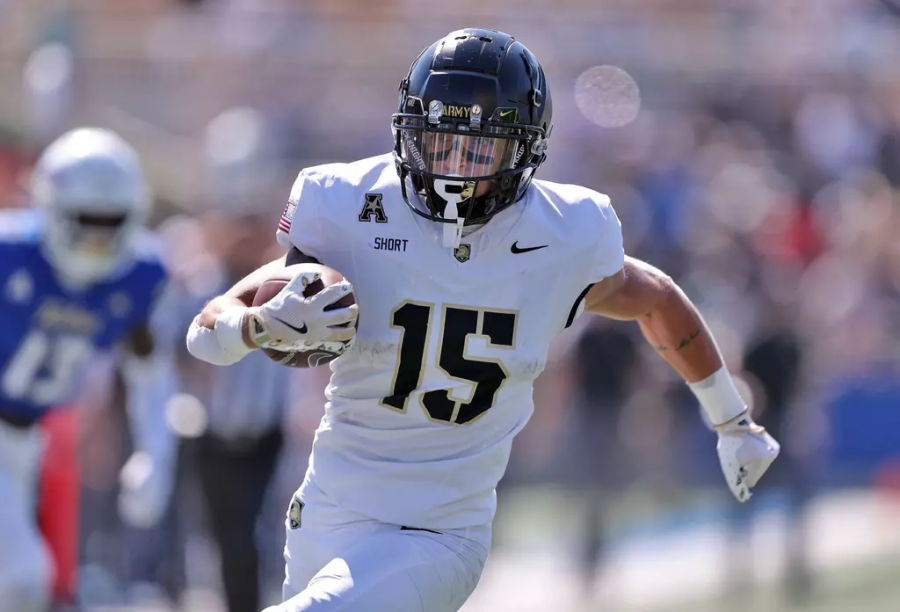
The margins at the elite level of any sport are miniscule. And you cannot deny that every hundredth of a second, every eighth of an inch, is valuable when it comes to being better than the guy next to you. But the NFL Draft can sometimes lean into the measurables too much, a comfort crutch for scouts who rely on numbers to rank talent rather than trusting their gut and using their eyes.
Noah Short has the numbers. His athletic testing will score in the high percentiles amongst all prospects. His height is good for a slot receiver. But the California kid who left home and tested himself in the toughest of environments brings much more to the table than that. How many draft prospects have embraced every role possible to help their football team win games? And when it comes to standing out compared to the next person, who else in this draft can say they are able to play running back and wide receiver, whilst also making an impact on special teams?
How do scouts measure character? In 45 minutes over Zoom I learn a lot about Noah Short; he has an easy, magnetic demeanour with a smile that I’d class as dangerous if I had a sister. He’s extremely polite and well-spoken, and flashes humour when we discuss his College Football 26 rating. He’s a man of his word, conducting the interview in the back of his car because he’d committed to it despite a schedule clash. But most of all he lives and breathes football and has an underlying determination that tells me he will do whatever it takes to be of value to a team in the NFL.
Fully focused on the two months ahead, Short has given little thought to draft weekend. Still having classes this semester, he’ll likely spend it in New York, 3,000 miles away from his family. Allowing himself a moment to contemplate what it would be like to get a call that would make him the first Black Knight drafted since 2008, you know the occasion will be up there with the blocked punt in his first ever Army-Navy game:
“It would mean everything. First of all, I’d just give complete glory to God for putting me in this position and keeping me safe. But I’ll definitely be emotional, thinking of all the hours that you put in – especially at West Point, when your time is pulled in so many different directions and you find yourself exhausted day after day. Just never giving up and continuing to fight and improve, it would just be my lifelong dream come true. For my family to see that accomplishment after all they did to help me get there; it wasn’t the journey we imagined, but it’s one I wouldn’t change for the world. I won’t stop between now and then, and if I get that call I’ll keep going until I’ve got nothing left.”
SIMON CARROLL
HEAD OF CFB/NFL DRAFT CONTENT
PREVIOUSLY THE FOUNDER OF NFL DRAFT UK, SIMON HAS BEEN COVERING COLLEGE FOOTBALL AND THE NFL DRAFT SINCE 2009. BASED IN MANCHESTER, SIMON IS ALSO CO-CREATOR & WEEKLY GUEST OF THE COLLAPSING POCKET PODCAST, IS A COLLEGE FOOTBALL WRITER FOR DAZN AND COVERS THE JACKSONVILLE JAGUARS FOR SB NATION.
A huge thank you to Noah for taking the time to talk to us. Everyone at The Touchdown wishes him well in his future career.